A Bloody History
The Chinese have no love for the Japanese. The two countries have bad blood between them dating back to Japan's days as an Imperial power. In the years before the collapse of the Qing Dynasty, China entered a period of turmoil that the Japanese took advantage of. They invaded the Korean Peninsula in 1897, wrested it from Chinese control and next occupied Taiwan in what would be called the First Sino-Japanese War. The Qing Emperor was forced to sue for peace, and the Japanese accepted while still determined to one day control the mainland and its vast resources. That opportunity would come when China was further plagued by civil strife in the period between the two World Wars. As Mao Zedong's Communists and Chang Kai Shek's Nationalists fought among themselves, the Japanese moved in to seize parts of Manchuria. Thus began the Second Sino-Japanese War.
 |
| Mao Zedong |
 |
| Chiang Kai Shek |
Even before the onset of World War II the fighting in Asia had spread deep inland. Beijing and Shanghai quickly fell, and in the winter of '37 the bloodshed reached the capital of Nanjing. After a futile defense of the city, Chinese soldiers and civilians alike were rounded up and butchered over a period of six weeks. A string of other victories followed for the Japanese but with each successive battle they found it increasingly difficult to maintain control over captured territories. The Chinese had already begun a policy of resistance employing subterfuge and guerilla tactics. This led to a protracted stalemate between Japanese forces and the United Front (a temporary coalition between the Communist and Nationalist regimes).
 |
| Japanese Invasion of China |
 |
| Imperialist Japan |
 |
| Communist China |
 |
| Nationalist China |
Elsewhere Japan's luck worsened as their position in the Pacific theater shifted from one of domination to a failing defense. Allied naval forces pushed closer and closer to the Japanese Archipelago, and with the fall of Iwo Jima, full-scale aerial bombardments began wreaking heavy destruction across the islands. The country was caught in a war on multiple fronts and suffered repeated blows to its production facilities and supply lines. Many leaders within the Japanese chain of command felt the war was lost and wanted to negotiate surrender, but the only surrender the allies would accept was an unconditional one, and that was unacceptable, as it would subject the emperor and imperial family to a war crimes tribunal. Fighting on all fronts continued with tens of thousands dying by the day.
The Nanjing Massacre aside (which included the gang rape of adolescents and alleged killing contests) perhaps the most heinous of the Japanese atrocities was the ongoing experiments by Unit 731. This biological and chemical warfare development unit conducted weapon testing, germ warfare attacks and vivisection on helpless Chinese prisoners. The experiments went on until the close of the war after which the members of the unit were given immunity by the United States government in return for the data they had compiled during their research.
 |
| Japanese Tanks Rampage |
 |
| Execution with Sword |
In the end the Chinese had suffered millions of deaths at the hands of the Japanese. The people’s hard-fought, so called War of Resistance ultimately ended with two bombs--one in Hiroshima and one in Nagasaki--that drove the invaders away for good. Sadly for the Chinese it did not get any better. The Communists and Nationalists resumed their fight for control and millions more died.
The devastation from the two Sino-Japanese Wars still remains fresh in the collective Chinese psyche. And Japan's long lasting position as the dominant power in Asia did not make it any easier for China to lick its wounds. The Japanese themselves have maintained an attitude of arrogance, even as China has overtaken them on the global scene. They still consider their large neighbor inferior, culturally and economically. Ask the common Japanese person and they will invariably admit that they see China as dirty, smelly and undeveloped. The local food they would not dare eat, and the people they think rude and uncultured. The media too serves to bias opinion. I'd say nine out of ten news stories related to China are negative in nature. After six years of hearing all the bad hype it was time I went to decide for myself what the country was all about.
 |
| The People's Republic of China |
Shanghai
I touched down at the airport and walked from the arrival terminal to the metro entrance. This made it very easy to get to the place I was staying. When I surfaced on the street I was surprised by how clean and new everything was. And mind you, I was not in the city center, but rather a residential zone to the south. One problem I did have though was that none of the public pay phones accepted coins. They only took cards which I did not find anywhere, so I had no way of contacting my friend. I next asked a tax driver if he recognized the address, but it was written in English and I could not pronounce it the Chinese way. In the end, he let me use his cell phone to make a call. That act of kindness gave me an immediately positive impression of the people and city.
 |
| Bundt Riverfront |
 |
| River Cruise Tour |
I gave myself four days to see Shanghai. It was more than enough time. After I went to the highly developed riverfront and checked out a few temples, I left the city for a day to see Suzhou. And I still had more time to spare so I went to a public pool with my friend. It was a very interesting experience. Most the people in the water were on the shallow end because they could not swim. And those who were in the swimming lanes cut every which way. In other words, they ignored the large red lines on the bottom of the pool, and did laps in a crisscross manner. This led to a lot of collisions. Lifeguards were on hand in case anyone got hurt.
 |
| Nanjing Road |
 |
| 229cm of Yao Ming |
 |
| Stone Marker |
 |
| Rain Play |
 |
| The only black men I saw in Shanghai |
Suzhou
I have it in mind to see 100 UNESCO World Heritage Sites before I become too old and feeble to travel. Before China I had visited 41. That incidentally is the number of sites in the whole of the country. However, there is not a single one in Shanghai. So I had to take the maglev train 45 minutes west to see World Heritage Site #813--the Classical Gardens of Suzhou. I arrived at the train station and caught a bus to the city center. A series of canals ran alongside the roads, and cut beneath at intersections. Large green trees stood on the sidewalks like columns, and the shops and homes behind them had a quaint appeal. The town, though touristy, was mostly untouched by overdevelopment and trendy commercialism.
 |
| Water Garden |
 |
| Circular Door |
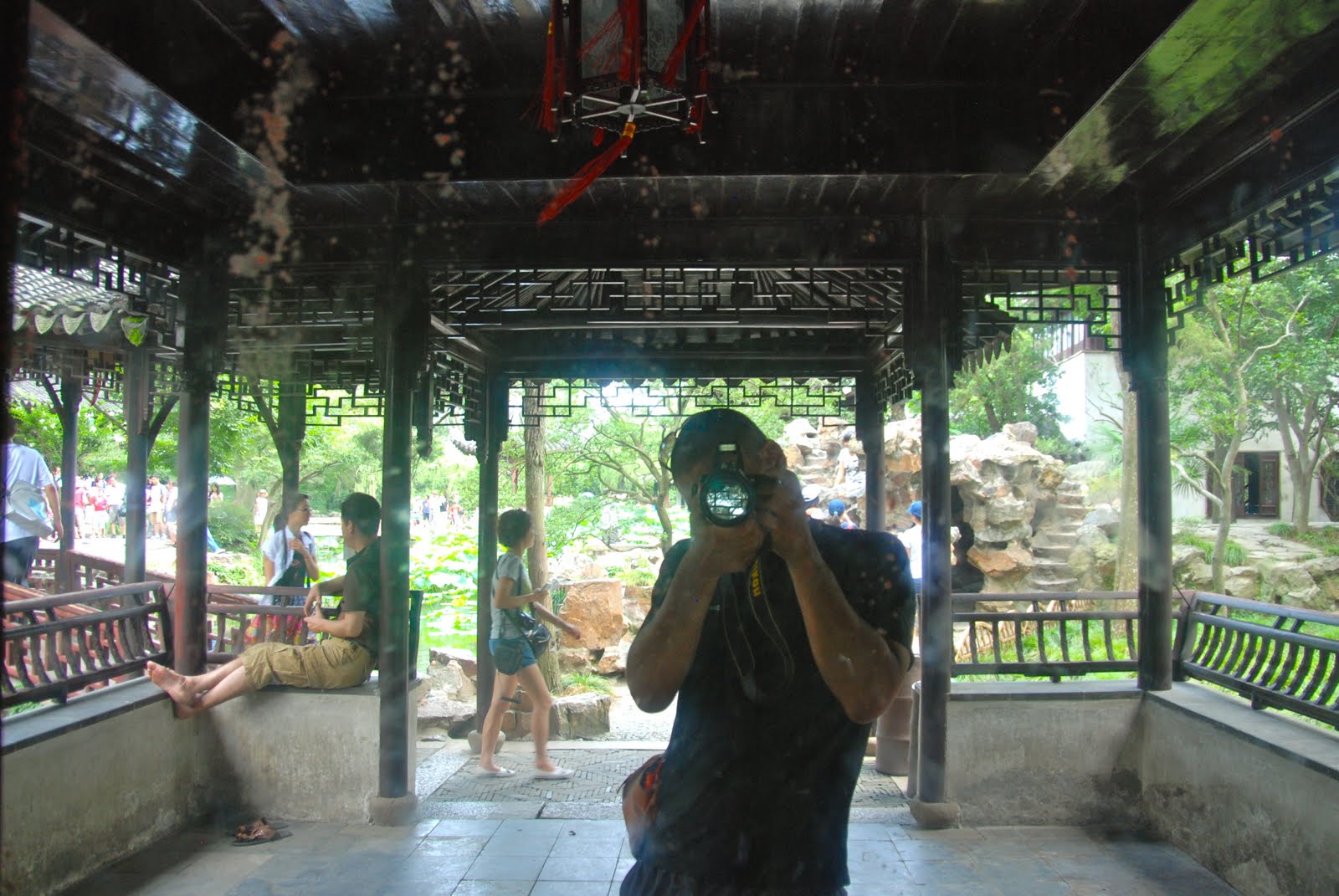
I paid to enter two gardens, both retreats of the former social elite. They featured the Chinese lotus and its large pink flower that shoots straight up from the plant's large floating leaves. Playing the tourist, I had to cover a lot of ground to see everything and take pictures. The weather was hot and sultry. Sweat soaked through my shirt and it stuck to my back. But I continued on undeterred. My one reprieve from the elements was the many vendors who sold ice cream. Even at the tourist price they were cheap and well received.
 |
| Lotus Flower |
 |
| Self Photo |
 |
| Suzhou Cityscape |
 |
| Old Tower |
 |
| Ice Cream for Sale |
Trains
While is Shanghai, I decided to visit Xian next. The cheapest way to go was by train. I figured I would stop by the ticket office the day before and book the trip. Unfortunately, when I got there they said the seats were all full. Not wanting to wait another night, I asked if there was anyway I could still catch the train. At that point they offered me a standing ticket. That seemed fine by me, at least until I understood that it was a 17-hour ride. Still, I went through with it.
When the afternoon came, I bought plenty of snacks in advance and headed to the station. Since I had no place to sit I claimed a small spot in the area between the carriages. A few other passengers were also stuck standing alongside me. One was clearly not Chinese. She looked at me, I looked back, and a minute later we were talking. It turns out the woman was from Suriname and she was in the same predicament. We both had to tough it out for 17 hours to get to Xian. But that never happened. A train employee offered us seats if we paid a 15 dollar upgrade. We gladly accepted and followed the guy to the dining carriage where he seated us at a table across from a family of four. The Surinamese woman, Kady, spoke some Chinese, and could communicate a little. I also had my Japanese to help out, since the written characters are borrowed from Chinese, and the meanings essentially the same.
 |
| Family on Train |
It was a long ride. We ate. We talked. I showed the family's two children my coin tricks. What we did not do was sleep. It was much too uncomfortable for that. And the people behind us never quieted down, not even at 4 in the morning. It was mostly this one woman who kept laughing, and her voice sounded like that of a chicken being strangled. I would have gladly paid again to be moved elsewhere, but the opportunity never presented itself.
Xian
The city of Xian is not very large or developed, but it is a major tourist spot. It is the main hub for the region and many fantastic places can be reached by bus within a few hours. I was there to see World Heritage Site #441, the Mausoleum of the First Qing Emperor, also known as the Terracotta Warriors. That being because, an army of life like clay soldiers was erected to watch over the Emperor's finally resting place.
 |
| Drum Tower |
When I found my hostel I felt far too groggy to go the tomb and thought it better to wait until the following day. That gave me that afternoon to explore Xian proper. As I wrote already it was not a big place so I walked to the Drum Tower and Bell Tower. And from there I stopped off at a bar for drinks. That was enough to satisfy my desire to see more. So I bought cheap beer from a corner store and enjoyed tithe hostel. The next morning I paid for my actions with a severe hangover but the throbbing did not stop me from visiting the tombs.
 |
| Xian Backstreet |
 |
| I'm not even going to try to explain this one |
I had always seen pictures of the Terra-cotta Warriors, the same as I had the Great Pyramids or Taj Mahal. And based on their renown, I expected something amazing. What I got unfortunately was a very crowded site with the statues far removed from the tourists. They stood is an excavated pit, and a lot of them were broken in to pieces. The statues had been like that, a result of centuries of neglect. Only in the last thirty years have archeologists been piecing them back together and of the 8,000 originals, some 1,500 are on display. For whatever the reason, I was not very impressed.
 |
| Terracotta Warrior Up Close |
 |
| In Rank |
 |
| The Big Room |
 |
| A Project in the Works |
Beijing
Another long train ride took me from Xian to Beijing. The difference was I got a sleeper seat. I had to share it with an elderly couple though, and the old lady kept giving me the evil eye. Or so it seemed. I can't be sure what she thought of me because she never opened her mouth to say a thing. Not that I would have understood her Chinese.
There are four different railway stations in Beijing that handle trains coming and going in the four cardinal directions. I arrived at the North station and had to take a very crowded street bus to get to the nearest metro station. From there it was easy to get to my hostel. The first place I went to visit was the Drum Tower. All the large cities in China had one and used it in conjunction with a bell tower to announce the times of the day. A variety of accurate devices were used to measure the length of an hour, and timekeepers were sure to strike the drums and bells accordingly.
 |
| Arm Wrestling in a Bar |
 |
| Nighttime on the Water |
 |
| The Forbidden City |
 |
| The Back Gate |
 |
| Detailed Masonry |
 |
| Taking a Break |
 |
| Guided Bike Tour |
 |
| Temple of Heaven |
Beijing, being the modern and historical capital of China, has an abundance of buildings to see, and boasts no less than five World Heritage Sites. Within the city itself are the Forbidden City, the Summer Palace and the Temple of Heaven. Of the three I would say the Summer Palace is the most amazing. The palace compound features a large manmade lake surrounded by willow trees and floating lotuses. A walkway makes a loop around the water and takes about two hours to complete. The Qing emperors built it originally as a large garden to enjoy recreationally, but over the centuries added in elaborate buildings symbolizing the varied architecture of other palaces in China.
The day I went it was rather overcast, but the scenic beauty of the palace still made for an incredible visit. I spent four hours looking around and when I left I contemplated the beauty I had beheld over lunch at a nearby McDonalds.
 |
| Stone Bridge |
 |
| Inside Palace |
 |
| Pavilion |
 |
| Roof Above Tower |
 |
| Beautiful Greenery |
 |
| Temple |
The Great Wall
No trip to China would complete without a visit to the Great Wall. The large edifice extends over 8,500 km along the northern reaches of the country, and is accessible from many cities. From Beijing it takes one hour to go to Badaling. Because Badaling is the part closest to the capital it is also the most crowded section of the wall. To avoid the tourists I went to Jinshanling instead which is a two and a half hour ride away. There were still some tourists but they thinned out the further I went from the main entrance. Eventually, I reached an unrestored part of the wall and found myself all alone. I could have continued on for another two hours and it would have been the same. The wall never ends, and most of it is crumbling and isolated.
 |
| The Entrance Gate |
 |
| It Goes on Forever |
 |
| Striking a Pose |
 |
| Restored Section |
Walking back, I imagined how it must have been to keep watch on the wall. The terrain to the north was mountainous and thickly forested. At night it would have been difficult to see an approaching enemy. But no army could cut up and down the mountains, so it was at the passes that the wall was heavily garrisoned. In the event the enemy did come, a network of towers made it easy to relay warning along the expanse of the wall. A sentry would light a signal fire and the other towers would quickly follow suit.
 |
| Through a Tower |
 |
| Overgrown with Weeds |
 |
| All Alone |
In its heyday the wall had 200,000 soldiers to properly guard the Chinese border from the Mongols. More often than not though, it was undermanned and marauders had little difficulty finding a way through, whether it be by force or by the use bribes. The great Mongol leader, Genghis Khan chose the first approach, and after his men had slaughtered the Chinese guards, he erected an earthen ramp so that his army could cross over while still mounted on their horses. After that the foreign invaders came and came until the whole of China fell under their power. In spite of its failure to protect the Chinese people, the wall stands as a remarkable architectural feat and a symbol of the nation.
Mao Zedong
It was after World War II that the Communists took control of China. The leader of the regime, Mao Zedong, drove his adversary Chang Kai Shek to Taiwan, and subsequently founded the People's Republic of China. He gave his inception speech at Tiananmen Square and quickly went about making reforms. His plan, the Great Leap Forward, was meant to transform the country from an agrarian economy in to an industrialized communist society, thus making China a world power in the process. But it failed miserably. Millions of people died from famine and persecution, and the nation experienced an economic regression.
 |
| Mao at the Entrance of the Forbidden City |
Just to show how misguided Mao was, he purged Chinese society of intellectuals and scholars, then went about enacting a multitude of flawed strategies that said intellectuals and scholars would have told him were doomed to fail. He, for example, had no knowledge of metallurgy but decided people could take scrap metal and turn it into steel with the use of backyard furnaces. Mao forced hundreds of thousands to setup the furnaces. And yet no one succeeded because high quality steel could only be produced in large factories by skilled metalworkers who possessed reliable fuel.
 |
| Propaganda Piece |
 |
| The Misguided Masses |
He also divided the peasantry in to agricultural collectives with the hope that they would increase crop output. Though the Chinese people had maintained an agrarian culture for thousands of years, he made them change their planting and harvesting processes in ways that had not been thoroughly tested. Ignorant as always, he believed farmers could increase their harvests simply by planting more seeds in the same area. He did not realize that plants of the same species would compete with one another for soil and nutrients. Crops grew stunted if at all, output decreased and millions died from the resulting famines.
And let's not forget the Great Sparrow Campaign, where Mao had countless traps set to kill off the pesky little birds. But by tampering with nature he eliminated a major predator of locusts. The insects proliferated in to rampant swarms and feasted on crops across the land--this when food was needed most due to widespread famine. His focus of industrialization also left fields to rot because he shifted manpower from the farms to factories mid harvest.
In spite of the disastrous results of the Great Leap Forward, Mao regained control of the Chinese government through shrewd political maneuvering, and in 1958 went ahead with his Cultural Revolution, a systematic elimination of religious and traditional elements within China. Another fiasco ensued. Millions were persecuted, the country deteriorated socially and economically, cultural sites were ransacked and ruined. And all the while, Mao developed a personality cult which grew to epic proportions. But the man's ego and propaganda machine could not mask the damage he had done to the country. Still, his inept leadership would continue on until his death in 1976.
 |
| Follow Mao |
Within half a decade, China rose to be the world power envisioned by Chairman Mao but in no part thanks to him. One in fact has to wonder how much sooner it would have happened had he not set the country back on such a grand scale. Plainly put, the devastation, grief and chaos caused to his own people was worse than what the Japanese had done during their bloody invasion and occupation of the mainland. Mao's misdeeds, in my opinion, earn him a place alongside Stalin and Hitler as one of the worst leaders in modern history.
Oddly, Mao remains a beloved figure in China with millions of people visiting him every year. His embalmed body is on display in a glass case inside his mausoleum in Tiananmen Square. I lined up for about 45 minutes to see it. A security check with metal detectors made sure I had no weapons or camera on my person. Next I knew, I was in a large hall that led in to a dimly lit room where Mao's body was. I had only about 6 seconds to look over as I passed by, but from 20 feet away I was able to clearly make out the corpse. A large Chinese flag covered his body with the head exposed face up. It looked as if he were sleeping. That was the last thing that went through my head as I left the building. Then I began to wonder if it was really him and not some wax dummy. The man died 35 years ago and I don't see how he could remain in such fine condition. I've heard past communist leaders Lenin and Ho Chi Min are also on display in Moscow and Hanoi. One day I'll have to take a look so that I can compare the three.
Food
There are no shortages of restaurants is Shanghai or Beijing. They are as ubiquitous as street signs; because you see them every which way you look. This is good in some ways, but bad in that it is difficult to choose which place to enter. And when you are finally seated inside and have the menu, it is equally difficult to decide on what to eat. Chinese rood is incredibly varied, and restaurants seem to have a bit of everything. As a result the menus are huge. An average restaurant had twenty pages worth of dishes to offer, and I was often stuck looking at the pictures not knowing what to order.
Thanks to my sharp eye and fine culinary inclinations, I most often chose tasty dishes. Everything from fried tofu, to boiled lotus root, to spicy pork. The one time I failed, was when I ordered little buns that were filled with fried chicken skin. From the picture I had thought the skin was a type of meat paste. Conversely, the highlight of many meals was the crispy duck. Whereas Peking duck is seasoned and smoked, crispy duck is breaded and deep-fried. The result is an absolutely delicious creation served with a spicy powder that gives the juicy meat just the right kick of flavor. Is it only me, or does everything taste better fried?
Day after day, I enjoyed the culinary delights of China and the best part was, no matter the number of dishes I ordered, or how much beer I drank, my share of the bill was never more than five dollars. And if I wanted to be thrifty I could go to the street vendors and fill my belly for under a dollar. Convenient stores were also dirt cheap. Ice cream snacks were around 40 cents, and a liter of bottled beer was something like 75 cents. Oh how I miss the savings already.
 |
Transformers Ice Cream
|
|
Beer and Spicy Tofu Strips
|
|
 |
| Leftovers |
 |
| Enjoying Kung Pao Chicken |
Pool
I mentioned earlier that I had visited a pool in Shanghai. It was a positive experience that left me with a renewed desire to swim again. In Beijing I had my chance. I went to the Olympic Park to take pictures of the Bird's Nest Stadium. What I did not know is that across from the stadium was the Cube. The large silver building looked like a brick of bubbles. Curious as to what was inside, I walked over to the entrance and discovered that it housed the Olympic pool. Moreover, anyone could go in and swim.
I immediately wanted to enter but I did not have my swim trunks, so I hopped back on to the metro and dropped by the hostel. A Canadian acquaintance was just waking up from an afternoon nap. I convinced him to join me. To the cube we went.
The building was quite large. It had a food court, a small waterside park and two Olympic sized pools. The competition pool was open to the public, but no one could use it. The visitors took pictures and lounged around in the spectators’ seats. The large Olympic emblem was up on the far right above the diving platforms, and the large room had a very unique feel. As I looked downward, I noted how Michael Phelps had won a record-breaking eight gold medals in the still water below.
 |
| Phelps for the Win |
In a large adjacent room was the practice pool. For a fee I was able to swim for two hours. The large pool had two sections. The one half was shallow, and the other deep. Normally, I would have done laps on the deep end, but I could only swim there if I had a deep-water certification. For extra money I could have taken the test, only I thought the whole thing absurd. So I stuck to the shallow end with all the Chinese people who could not swim well. It was not so bad. The lanes were divided by floating rings, and the kids kept to the open play area on the far right. And above all else, the pool did have that incredible Olympic feel to it.
 |
| The Bird's Nest Stadium |
The China of Today
China has had a long, long history. Back when I was teaching English in Taiwan my host father once said that history was the most difficult subject at school because of how much material the students needed to memorize. I can believe it. We are talking about four thousand years of civilization with hundreds of kingdoms and countless rulers. Over that time there have been many ups and downs. If we were to look at a timeline that measured China's economic strength and social stability, there would be a major drop dip toward the end with an abrupt rise. This is because the last 150 years of Chinese history have been dismal. It began with the negative influence of British and French Imperialism. The two powers went in the 19th century and forced opium upon the country, undermined the ruling authority, and eventually precipitated the downfall of the Qing Dynasty. Political unrest followed setting the stage for the Japanese to come and slap the Chinese around. Next was civil war, a World War, another civil war, and thirty years of Mao.
In 1976, when Mao died, China was the most populous country in the world, had abundant resources, a rich culture, a nuclear program, and a longstanding desire to be strong and proud--yet the nation was in complete chaos. The people were repressed and subject to widespread suffering. The government was fragmented. Relations with the Soviet Union and America were tense. Japan had stepped up and dominated the Asian market.
China needed change. It needed a true leader. Someone who could succeed where Mao had failed, a figure who could awaken the sleeping dragon. Fortunately, the right man had been there all along patiently waiting for an opportunity. His name was Deng Xiaoping, and with him began China's meteoric rise to greatness.
An ardent communist, longtime politician and former militant, Deng had fought the Japanese during the War of Resistance and helped drive the Nationalists out of China. He supported Mao in the years that followed, but fell out of favor with the Chairman and was twice purged from politics. In the end, Deng outlasted his adversary and seized control of China by opposing the Cultural Revolution and those who had been behind it. This gained him much support from the people allowing for a 'second generation' of leadership to emerge. Starting a new trend, Deng chose not to physically harm or jail political opponents who had fallen out of power, thus showing himself to be both pragmatic and forgiving.
 |
| Comrade Deng |
Under Deng's leadership the government enacted economic reforms that opened the country up to international trade and foreign diplomacy. His actions were far removed from the Maoist line that had once dominated Chinese politics, but the transition was a peaceful one, and rather than vilify Mao for all his mistakes, Deng openly said that "Mao was seven parts good, three parts bad." The new leader also made no attempt to develop a personality cult and took no major titles. The positions of Premier and Party Chairman were instead occupied by his protégés and the three men worked in unison to strengthen the country's global economic position.
 |
| Tiananmen Square Protest |
Deng traveled abroad to meet with foreign leaders and dignitaries. He toured Boeing and Coca Cola factories in the US to encourage them to enter the Chinese market. He became the face of China not only domestically but abroad as well. His influence and power however, were cut short by the Tiananmen Square Protest in 1989. The political backlash forced Deng to step down and pursue a quiet life outside of government. His work already done, China continued along the path he laid down. The country has prospered ever since.
In Conclusion
The Japanese are wrong. China is not the backwards, filthy country they believe it to be. In the places I visited, it is developed and orderly. The food is delicious and the people are kind. I would even say they are nicer than the Japanese, though the latter are much more polite.
After returning to Japan, I discussed the trip with my many classes and stressed the above points and that the stigma the Japanese have attached to China is based largely on misconceptions. Well, perhaps they may have been true fifteen years ago, but the country has developed dramatically, and with the Beijing Olympics of 2008, China has shown itself to be a big player on the world stage.
I highly recommend anyone visit the country to see for themselves.
 |
| Hmm...where to next? |