Tuesday, June 25, 2013

Photocentric


A Journey Begins

Back in 2002 I did a bicycle trip along the Mediterranean coast of Spain. I started in Valencia and rode as far as Cadiz. It was summer, the temperatures were in the hundreds, and still I was pushing on at about 80-100km a day. At the end of each leg I would ride my bike up to the shore, change into my trunks and swim in whatever beach I had happened upon. To say the least it was an amazing adventure.
Another day, another beach
At one point, after a swim somewhere in the vicinity of the town of Aguilas, I peddled in search of a place to set up camp. A large square lot overgrown with bushes and other unruly vegetation caught my eye. It was the perfect place. No one would see or bother me for the night. So I went in on a small footpath, and low and behold, in a hidden clearing there was already a guy with his tent. He recognized me as a fellow traveler and tried to speak to me in broken Spanish. I asked if he knew English. It turned out he was American.

The scruffy, sunburnt, twenty-something man was on a year long trip around Southern Europe, and whether it was by bus, train or hitch hiking he had already covered thousands of kilometers. And the things he had seen. They were astonishing. Places like secluded caves in Greece, small town festivals in Italy, and endless sunflower fields to the west where I was headed.

"And I've got the photos to show for it," he said with a gleaming smile. He pulled out a black bag and produced a huge SLR camera.

"Jesus. You've been carrying that monstrosity around with you?"

"Of course. How else am I gonna take photos?"

"I dunno. Maybe with one of these." I took out my own camera and showed it to him, a small, plastic Fuji disposable model.

The man laughed. "You're here in this beautiful, mind blowing place, and that's what you bring?"

I was almost offended by this response. So what if I had a cheap, disposable camera? I was taking pictures all the same.

Oh how ignorant I was then.

The truth be told, that disposable camera was a piece of garbage which barely took serviceable photos and only in the most optimum of lighting conditions. It pains me to think of all the places I traveled and used them. There was, for example, the time I biked the Road to Santiago pilgrimage route in northern Spain. I started in Roncesvalles in the Pyrenees Mountains. A thin layer of pristine snow had blanketed the local monastery right before I arrived, and soon it was on to the lower lying areas of Basque Country where I rode through small villages characterized by colorful triangular rooftops and eaves that nearly touched the ground. The place was so utterly breathtaking, it were as if I had leapt into the pages of a storybook. Then after another week of intense legwork, I arrived at the massive Gothic cathedral in Leon. It was the day before Easter and the elderly nuns dragged me to prayer service. We went to a small side room lit with candles and I sat quiet while they sang in the most angelic of voices. And here I am today with no pictures to show for it. I have only my memory of that event which grows fainter by the year. I no longer even remember what the kind faces of those women looked like.

In my life there have been a dozen such trips. And over the years I began to realize I should be taking more pictures. But I never cared to spend the money on a nice camera let alone make the effort to figure out how to use one. Another problem was film development. It was such a hassle and I didn't like the idea of replacing rolls. So I stuck to disposable cameras. I suppose that is something, because even crappy pictures are better than no pictures at all.

Anyhow, here are some photos from what I now dub my "Disposable Era of Photography."
Studying abroad in Yokohama 
Hitch hiking back after 3,000km bike trip in Chile
While teaching English in Taipei
Anti-APEC demonstration in Chile
Korea War Memorial in Washington DC
 Statue in Sendai during hitch hiking trip
Cathedral at end of Road to Santiago 
Favorite bar in Madrid
Rock of Gibraltar
Enter Japan

Well, eight years ago I came to Japan. My dad had insisted I take a cheap digital camera with me. It was easier to use than a film one, but I still employed it sparingly. There were the big trips to Europe, Korea and around Japan as well as some photos in Tokyo. A few months into my stay a friend pointed out that the camera was outdated. He said I should get a new model because in Japan you could get them at the best price. I heeded his advice and went to the Big Camera store in Shinjuku. Without giving it much thought I purchased one of the cheapest models on the floor, a Nikon Coolpix digital compact.

The Coolpix was a definite improvement, though looking back it was still not a good camera. I became frustrated not being able to take decent photos indoors. But I had got the thing and was determined to get my money's worth. So I used it when I traveled around Japan and overseas in the US, Thailand and India. In spite of the camera's weaknesses I was still able to get the occasional good shot.

I now present photos from my "Compact Era of Photography."
Beach in Colombo, Sri Lanka
Kichijoji Park, Tokyo
Temple ceremony in Seoul, Korea
Fruit vendor in Kanchanburi, Thailand
Beach in San Diego
Eiffel Tower
Jeronimos Monastery, Lisbon
Yakiho Shrine, Niigata, Japan
Meat Vendor, New Delhi

The One Named Akira

I very well may have continued to use the Coolpix camera on my second trip back to America had it not been for one fateful encounter. Allow me to elaborate. I have a friend who is a train conductor in Ishikawa prefecture. I went up to visit him for a special occasion. Some of his other friends had got together and chipped in to rent his train for a back and forth trip on the Noto Line. They wanted to have a party onboard while he was driving. The day of, I got on with my box lunch and canned beer. A young woman had brought her guitar and played mellow blue grass tunes, kids ran up and down the aisle, and I used my digital compact to take pictures. Then I noticed a guy with a big fancy Canon DSLR camera. I pointed him out and someone told me he was a pro photographer by the name of Akira.


Akira, years later in Kenroku Park

I stared at him for a while, and I couldn't stop thinking how cool he looked with his camera. His hand worked the buttons on the body and the other twisted the lens, and not once did he remove his eye from the viewfinder. He was so confident and graceful in his movements that I became determined to talk to him in the hopes that some of his photo taking mojo might rub off on me.

I later introduced myself and said, "That's a nice camera you got there."

"Yeah. Well, I thought I'd bring my high end model for the occasion."

"You mind if I see it?"

"No, not at all. Go ahead."

I picked up the black beast and weighed it in my hand. It was dense, blocky and of solid construction.  "Can I take a shot?"

"Sure."

I peered through the optical viewfinder and marveled at its size and clarity. Next, I zeroed in on the lady with the guitar. My finger pressed down on the button, and the frame flashed black while the shutter made a crisp sound. It was a sublime moment.

"So what do you think?" I asked, showing Akira the picture on the camera's LCD screen.

"Wow, that's pretty good."

"Really? But anyone could take nice pictures with a camera like this."

"No. That's not true. A consistently good photographer must have an eye for it."

"An eye eh? But how would I know if I have one or not?"

"Let me see your camera. I'll tell you."

I handed over my small Coolpix compact. Akira turned on the LCD screen and toggled through the pictures. On every second or third photo he paused a moment, and then continued on to the next. When he was done he gave the camera back and said, "You definitely have potential."

Those simple words weighed in the air, and as they sunk in, something inside me changed. I was from that moment set on improving as a photographer. First I went back to my town and picked up a used D80 Nikon DSLR along with a 18-200mm Tamron lens. That became the camera setup I would use for the next four years. We went many places together--America, Egypt, Australia, Mongolia, China, the Philippines, Laos and so on. However, I still remained a point-and-shoot photographer. I let the camera do everything without thinking about the technical process that produced the images. This limited how I could improve. So while I did develop a greater sense of light and composition, that was about it.

Well, that brings us to my "Point-and-Shoot Era of Photography." Here are some photos:

Mongol prayer mound
Great Pyramid
Inuyama Festival
Taos Pueblo
Forbidden City
Neighbor's shack in flames
Monument Valley
Hikonyan
Grand Canyon
Technicalities

The next big step came in March of last year. I bought a brand new D5100 Nikon and it did not come cheap. To justify the purchase I needed to to take my photography skills to the next level. I began by studying the basics. There was no shortage of free information online. I read up on ISO, aperture and shutter speed--the three settings that determine exposure. Any current model will automatically set these based on what the camera's sensors meter, the result of which is a nicely exposed image. But the system is not perfect. It flounders in low light situations and does not always provide the ideal depth of focus. An understanding of how a camera's sensors meter light and other ambient conditions is also important to optimize performance.

A camera is a complex tool. Between the time a person presses the button to autofocus and clicks for the shot, over a dozen technical processes are involved, many of which can be altered in advance using the different function buttons. How these are set will drastically change the final image, sometimes for the better, and sometimes for the worse. To know the difference is a matter of trial and error. I'll give an example. When taking an up close picture of a flower or food it is best to use a narrower aperture. This will compensate for the shallow depth of field and bring more of the object into focus. The trade off is that less light will reach the image sensor and the photo will require a longer shutter speed to expose properly. Boosting the ISO could help shorten the shutter time, but it will come at the cost of noise, those grainy points that detract from the quality and detail of an image. This can become an issue if you are in a dimly lit bar trying to photograph your buffalo wings. The picture might blur, turn out underexposed (dark), or be too noisy. But in a bright area, enough light will reach the image sensor to allow for a nice, quick exposure regardless. And I didn't even touch up on using the flash. That is a beast on to itself. When used carelessly it ruins the look of an image by making the subject appear bright and burned out, especially the faces of people. Yet for every problem there is a solution. A change in equipment may be necessary, the most essential of which is a lens swap.

For the time being no lens can do it all. Each has its strengths and weaknesses. A zoom lens for example lets you move in and out for added flexibility when framing a shot. That of course is a good thing. Its weakness is that the lens has more internal elements which cause greater interference before the light reaches the image sensor. This leads to a loss in sharpness and some distortion. Sharpness is also affected by the aperture of the shot. Every lens has its optimum sharpness aperture setting and shooting at that setting will give the clearest image of a subject.

You also have to think about what lens is best suited for what situation. If you're out to take pictures of birds nothing but a telephoto lens will do. Those provide major zoom power and you'll need it because there's no way you are going to get close to the winged critters unless you're shooting pigeons. And let's say you want to get photos of stars. In that case you should use a wide angle lens. It will bring more of the sky into the frame, and allow for longer exposure times because the large frame pushes the stars farther back. Mind you, stars are not stationary, and the closer they are in the frame the quicker they move. Think of a ship in the distance. It passes at a slow speed. But if you're right next to it, it will zoom by. Anyhow, after about twelve seconds stars begin to trace lines. For really long exposures this creates circles or semi circles. You will also need a tripod to keep the camera in place. Lastly, an understanding of weather and light pollution is critical. It is best to shoot on a cold moonless night, or after the rain, when the sky is clearest.  

Shy swallow
Milky Way over Wyoming
I've learned a lot about photography, and it is knowledge I have applied and/or gained in the field. This past year I think I took around 20,000 photos. Perhaps more. Anyone who knows me knows that I take my camera everywhere now. I guess the same could be said for a person with a current cellphone. But the difference between a smartphone camera and a good DSLR is like that between a Honda Civic and a Lamborghini Diablo. While both will get you from A to B, the degree of performance is what sets them apart. Once you truly feel and understand that difference you'll never want to go back to using the former.

And it is not only the volume of photos taken or having the right tool that matters. The lengths a person goes to to get their shot also determines the quality of the result. My crab photo outing from the other day is a good example of this. By my apartment I often saw the eight legged things crawling in the shadows and decided it was high time to corner one to photograph it up close. So I looked around and discovered a ditch behind the building parking lot. It was filled with rain water and had become home to hundreds of the crustaceans. Unfortunately, when I drew near they disappeared into the bushes, cracks and little holes they had dug. To get some pictures I had to capture a small one. But even then the thing kept moving, trying to escape from my hand. I was using a macro lens and extension tube which narrowed my frame down to only about one inch across. In that situation movement of any type will screw up the composition. Moreover, autofocus is useless in macrophotography because of the very shallow the depth of field. You can imagine the difficulty involved, and after struggling to get some decent shots l was still not satisfied. What I really wanted was a photo of a big colorful crab. The problem is those suckers have formidable pincers and I wouldn't dare pick one up. I needed to use a stick to sweep a fancy, red male into the open. He was extremely fast and did everything in his power to get away. But with my stick I kept the crab where I wanted him. After about five minutes he grew exhausted and stopped, drawing his limbs in towards his hardened carapace. The game of cat and mouse had payed off. I now had the opportunity to get my up close shots.


Got ya!
In the end this photo outing entailed a fair deal of embarrassment. I mean people were going to and from their cars while I was scrambling around on my knees at the edge of the parking lot with an oversized camera. I must have looked like a looney. But I was too absorbed in the task to care. What can I say? Consistently good photos do not come without sacrifice. So while an amateur takes one shot and walks away, the pro might take 30 or climb a wall to get a better angle. Combined with a greater understanding of the technical aspects of the art it is easy to understand why their results are a step above the rest.

Anyhow, the whole focus here is on my development as a photographer, which I feel is linked to my environment. In that regard I am fortunate to be in Japan. This is the best place for taking photos. Many will disagree with such a brazen statement but in my mind not a single iota of doubt exists. Whether a person visits one of the country's massive, hyper modern cities with their abundance of fashionable, self absorbed youths, or sees the rural farms and the gentle elderly hard at work, there is a wide variety of things to shoot. But I do not base my assertion on the photo opportunities alone. It is also about the how the people here view photography.

If you by chance come to Japan and you will see that this country promotes and appreciates photos to a greater extent than any other place. It has effectively become the photography Mecca of the world. Just look at your camera. Chances are the model is a Japanese brand. The same goes for your lenses. That said, every picture you take has a little piece of heart and soul that came from the engineers who made the tool, and none have done more for camera innovation in the last 50 years than the Japanese. Even so, there is little to no ego involved. That is what I like most about photo taking here. It is not about who has been at it longer, or whose camera is better. The people do it for their enjoyment, and their lack of competitiveness also makes them very willing to share their techniques and insights with others.

Common sight in Japan
Thanks to this wonderful country I am now a better photographer than before. And I pride myself on this. My crab shots, for example, are unlike anything I have seen. I'm sure I could find similar, if not better photos on the Internet, but among the people I know, I alone can take such shots. The same goes for a fair amount of my work. To a larger extent though, my passion for photography is driven by my outgoing spirit. I was never one to stay at home. I go many paces and do many things. By taking photos I am able to share those experiences with others. That is what keeps me shooting. Not to be better than the rest, but to capably capture the majesty and beauty that I see in my life. The images I create will one day help me to remember the good times as well.

An Open Heart

Over the years I have also learned to find beauty in the mundane. Seeing how I tend to focus on the positive side of things, it was an inevitable outcome. And that reminds me. A Japanese friend once told me that after viewing my pictures on Facebook she had thought only a person with an open heart could have taken them. I laughed. They were flattering words but I didn't understand what she was getting at. Now, having given it some thought, I think I do. Everyday I look for beauty in my surroundings and I am very generous with what I would classify in that category. It could be a father holding the hand of his young daughter, a leaf caught beneath a windshield wiper, a cloud hanging low on the horizon, the wild curvature of an exposed root, or how light reflects off a puddle. Many people are oblivious to the subtle wonder of these things. And yet I who have seen and experienced so much of the world in my 34 years am still impressed with the simple charms of life's everyday facets. It takes a certain kind of outlook to carry on in such a manner, or perhaps, just an open heart.

I shall leave you now with pics of what I call my "Open Era of Photography."


Foggy forest
Temple guardian
Happy to weave
Prayer
Waiting for lunch
Old roof


Thursday, May 16, 2013

Year Five


Testicular Cancer

In 2008, five years ago to this month I had surgery to remove a tumor from my body. The eventual analysis of the tumor's cells showed that it was cancerous, and the doctors said I needed chemotherapy.  At this point I considered getting treated back home. That route, however, was an impossibility due to my lack of insurance in America. So I remained in Japan and underwent three rounds of chemo. I could not work during that time. Nor did I have an apartment because my company had forced me out of my former place once I stopped teaching. To get by while I was in and out of the hospital I relied on the kindness of friends. From one day to the next I slept on a floor. But that didn't bother me. I was happy just to have somewhere--anywhere to spend the night.

Post surgery
This period of treatment was a major downer. I had so many dreams and hopes shattered by the onset of my illness. For one, I had planned to soon start a Master's course, but that would not happen for several more years because of the financial setback the cancer situation created. At the time it seemed like it might never come to pass. The future had shifted from a firm and tangible horizon to a dark, cruel shroud of uncertainty. That was for me the most difficult thing to handle. I had lost control over my life and the direction in which it was headed. Slighted by my own health, I did not know when I could work again, or even where for that matter.  But I was certain I would become better. I told myself from the beginning no matter how dire my circumstances became I would fight and pull through. A person with operable cancer has little other choice than to think that. Listen to the doctors, get the treatment, and hope for the best.

After four months my chemo ended. I had follow up tests and they showed that I was in the clear. I could now return to work, but another three months passed until a position opened up in Gifu. It was there that I rebuilt my life. I threw myself into my teaching and saved up money to travel and do the other things I enjoy. However, the threat of recurrence still loomed heavily on my thoughts. To be sure I was free of the illness I went to the hospital every few months. A blood test checked for tumor markers and a CT scan showed if any irregular growths had developed in my abdominal lymph nodes.  Prior to my original treatment it was there that the doctors had told me the cancer metastasized.

These trips to the hospital have continued for years. In fact, this very morning I went in for the results of some tests I had undergone two weeks ago. At this point the possibility of recurrence is very low, yet recent stomach pains had me worried. The cause could be any number of things but in the back of my mind I had feared it was from the swelling of my lymph nodes. So I was quite nervous while I waited to be called into the doctor's office. Once inside, he asked me to take a seat and brought the results of my tests onto his computer screen. Doctors in these situations never get to the heart of the matter right away. They show you numbers and images that are indecipherable to the common man, and say something along the line of "this *data* here, and this *image*, and oh yeah, this *information* too, well, it all indicates....."  and that's when they finally share the verdict. As I leaned forward on the edge of my seat, the doctor told me I was still cancer free.

What he couldn't tell me was why I had stomach pains. I didn't care. I breathed a sigh of relief and left the office feeling like I was emerging from a large, seemingly endless cave in which I had lost my way.  Outside the sun greeted me with a kiss of warmth. The sky was blue, the trees shone green and all was right in the world. I hopped in my car and drove straight to work, arriving in time for second period. The class began with greetings. "Good morning," I said to the thirty something teenagers seated before me. "How are you?"

"I'm fine, thank you" said a boy.

"I'm hungry," said another. "And you?"

"I'm great." For once I really meant it. "Five years! Five years! Five years!" echoed the words inside. Never had they sounded so sweet.

Making Sense of It

As I type this I still have so many thoughts running rampant through my head. The past, the present, and the future, in my mind they've always been anchored against the tide of cancer. I catch my reflection on this computer monitor before me. In it I see the man I am, one shaped by an experience I hope none of my friends will have to suffer through.

Life is not so kind though. A few months ago Vicky, a British girl I had befriended in Gifu, was stricken with breast cancer. When I found out my heart went out to her. We met the night before she left for London and it was so difficult to say goodbye. I knew very well what awaited her, and I wished at that moment I could have frozen time to spare her from the pain and anguish. But I am no such magician, and I could do no more than to hope that the forces at play grant her a quick recovery. She continues with her treatment to this day. From what I understand it is going well. In time she will be better, and then it will be a long walk forward until she too steps outside the shadow that the threat of recurrence casts.

Before Vicky left
I think of another friend at this time as well. His name is Ryota. We met at the hospital in the same ward undergoing the same treatment for the same type of cancer. We were both 29 as well. What were the odds? Needless to say we became fast friends.

Because my family was in America at the time they never visited me. Mom wanted to come but I talked her out of it. I didn't want her flying half way around the world only to sit by a hospital bed. "Wait till I'm better," I told her. "Then we can do something fun." That said, I felt a certain loneliness being separated from my family during such a trying time. But then appeared Ryota and his family. I remember when his mother came into the ward and saw me lying in the bed next to her son. Ryota introduced me, and she did not hesitate--not for one moment--to take me in beneath the fold of her warmth and affections. And like that I became an adopted son of the Yamigawa family.

With Ryota, his daughter and mom
My friendship with Ryota is a special one. When people ask how we met, I always tell them, "it was through the most unusual of circumstances." I say it with a laugh because its one of the few occasions that I can use the expression truthfully and without hyperbole. And for five years now we've been friends. Following our dismissal from the hospital, I've seen him when I can. The last time was in February. I went to Ishikawa prefecture where Ryota is a train conductor. He has a wife named Kumiko and a young daughter Minori. Had Ryota succumbed to the illness they would have been at a great loss. Me too, for I absolutely love the guy.

Towards the end of my stay we visited a hot spring facility. Ryota and I sat shoulder deep in a large pool of steaming water. Behind us a wide window faced east into the night. Flakes of snow collided against the pane, but you'd have thought it was raining because of how quickly they melted. In this setting we talked, and the conversation turned decidedly profound, similar to one that takes place around a camp fire at night, or on the clear mountaintop.

"Life is a gift," I said to him, "But we sometimes fail to appreciate it. You know, like so many other things given to us."

"I can't disagree with that."

"Well, after the cancer do you think you value your life more?"

"In some ways perhaps."

"For example?"

"I may have never seen my daughter grow. I may have never again pulled back on the brake of a train and felt it yield. Those are the things I live for. I realize that more than before."

"I know what you mean. It could be something as simple as the sunset. When I see one I know it will be there every evening without fail. But one day I won't be alive to witness those colors, that brilliance of light. I understand that more now too. And the sunset seems so much more beautiful because of it."

Ryota leaned back deeper into the water and tilted his head upward. "It's good to be alive," he said with a sigh.

"It is."

Still going strong
The Simple Truth

Life is precious, yes. But everyone understands that. The experience with cancer taught me another, more important lesson. That of freedom and choice. We live to do the things we want when we want, and in that we find happiness. But when we are no longer free to exercise that control over our lives we feel trapped and frustrated. For me, when I had cancer I was in such a position, and it made me miserable for eight months. So once I became better and was free to act as I chose, I made good on the opportunity.

Even now the drive to enjoy life burns strong in my heart. There is so much to do and see, and if I don't act out, I feel like I am watching this existence of mine flicker by, while piece by piece it vanishes meaninglessly into the past. Before I did not think this way. I had become somewhat complacent. Now I am awake. Beauty, majesty and good times can be discovered at every turn, but we must first take the steps to get there. To an extent we are free to do so though not all of us choose to exercise that freedom. Life becomes routine. The years blend together. Only a few highlights stand out. Then we realize decades have passed and with them those freedoms that only young age and good health could afford us, at which point it is too late to do a damned thing about it. So we try to take satisfaction in what we've gained along the way and project our hopes onto others. That though is not the path for me. 

Life is in the freedom of the moment. Cancer has shown me that. I have more focus, volition and urgency in my choices than before because of it. There are no guarantees to count on. I must make the most of what I have now...while I still can.

So much to see and do


Friday, May 10, 2013

Golden Week


Vacation Time

Golden week this year was good. Then again, it's always good. I first stayed at a cabin in Nara prefecture with friends where we had a BBQ. The next day we went hiking in the mountains. After that I was thinking I'd spend the remaining two days of the holiday in the area on my own. But on second thought I returned home. I was stepping off the train when it occurred to me to drive south. So the next morning I got in my car and I was off.
Cabin We Stayed At 
BBQ Time
The local highways ran from my town of Toba into adjacent Shima. Then it was on to Minami Ise. I stopped the car whenever something caught my eye to take pictures. At some points I also veered off the main highway onto roads that went to the small port villages. Again it was about taking pictures and getting a feel for the area.


Things did not get interesting until I reached the town of Kihoku. And by town I mean a large expanse of land with a few villages scattered along the main roads. All else was rugged coastline and hills. The sun had now begun to set and I was not at all interested in returning home. In the back of my car sat a thirty dollar tent I 'd got the summer before at a Wal-Mart in America. I did not know where I would be camping that night, and I was not too worried about it. The matter would sort itself out in good time.

Town in Minami Ise 
Flying Carp
Pulling Poles
At yet another port town, I passed by a hot spring facility. I would definitely be going for a soak, but not before seeing the beach that road signs indicated was another kilometer away. This beach it turned out was nothing impressive. I was about to get back in my car and drive away when I saw a local tourism board with a map. The large, colorful board showed all the nearby places of interest. One was an observation deck. According to its description the deck offered exceptional views of the sunrise. I made up my mind to camp there and wake up in time to see my first sunrise of the year.


The hot spring facility I had passed by early was rather crowded with holiday travelers. Still I went in and soaked. As always I had to do so in intervals. The water was much too hot to tolerate for more than a few minutes at a time. To cool off I needed to get up on the edge of the bath and because I was the only foreigner present I drew some stares. But I did not care. After eight years in Japan I am used to it, even when sitting naked surrounded by a bunch of other naked guys.

For me the best part of visiting a hot spring is at the end. Once I am dried off and feeling refreshed I'll sit in a coin operated massage chair. The facility had one in the lobby. 100 yen bought me a 10-minute full body massage. I sat with my eyes closed while the mechanical fingers of the chair dug into my neck, back and calves, humming and clicking with every movement. When time was up the chair fell silent. I got up, cricked my neck and strolled over to a vending machine. A bottle of cold, whole fat milk was exactly what I needed, and that is exactly what I got.

Rice Seedlings
Hot Spring
Starry Night

Night greeted me outside. I now wanted to get to Tatsukayama Observation Deck. I sat in my car trying to remember the roads on the tourist board map. Was the turn off after the next tunnel on the highway, or the second? I don't use a smart phone or navigation system of any type when I drive, and this often makes it hard to find places. It’s both good and bad. I sometimes lose my way but the effort makes the journey more memorable, and I might discover a little something interesting I'd otherwise not have chanced upon. In the case of the observation deck I missed the sign that indicated where to turn off the highway. It was by then pitch black and the flow of traffic on the highway had been pushing me along faster than I wanted to drive. I finally stopped at a gas station and asked an old attendant in an orange uniform for help. He explained that I had gone to far and thanks to his directions I was able to backtrack to the right location.

The night was moonless, and in the rural town of Kihoku, little to no light polluted the sky. I stepped out of the car at the observation deck's parking lot and gasped at the sight of the stars overhead. To the left a path zigzagged up the hillside. It had no lighting and a canopy of trees and thick foliage casted endless shadows. I made my way up through the darkness. Being there alone did not make it any easier yet I was resolved to scout out the observation deck above. After ten minutes I emerged into a hilltop clearing. There stood the deck, shaped oddly like a UFO. A grass lawn surrounded it and I knew that was where I'd set up my tent. However, I first wanted to take pictures of the night sky. Without my tripod this was no easy matter. I placed my camera on the ground and angled it upward with my wallet. But because it was so dark I did not realize I still had a circular polarizer filter on the lens. The filter works like a pair sunglasses. It blocks out light but provides better highlights and deeper colors. The problem was that less light reaching the camera sensor made it more difficult to photograph the stars. Still, in spite of my slip up, I managed some shots, albeit noisy ones due to the high ISO setting I used.

Observation Deck
Next, I pitched the tent and got in with my sleeping bag. Wind beat at the nylon sides and the leaves of nearby trees rustled. At times I also thought I heard an animal growl or footsteps in the distance, but I knew better than to become frightened. Experience has taught me that all manner of strange sounds fill the night air. They are perfectly normal. I've also learned it is best to use a mat when camping. More than providing comfort as a soft surface, a mat acts as a thermal buffer between the body and the ground. Unfortunately, I did not have one. I soon realized I was not going to get any sleep lying on the cold ground, so back to the car I went and in the driver's seat I slept.

At 4:30AM my alarm sounded. I journeyed back up the hill. In the blue haze of predawn the zigzag of a path no longer appeared sinister as it had the night before. At the observation deck I faced west and sized up the bay. Islands big and small carved black chunks from the pink, glossy surface below. A blood red sun came up within minutes. It slowly climbed above the water and the color becoming more of an orange the higher it went. Small boats moved in the distance. They were dragging nets along the water and their wakes created v-shaped ripples. The scene was spectacular to behold and joy to photograph.

Before Sunrise 
Around 5AM 
Tent
Last Shot
Sacred Route

Many pictures later, I returned to the car and continued south still not knowing how far I would go. The highway was empty at such an early hour. It continued on through small villages and water logged rice fields toward the next city of Owase. I thought I might stop off there. With only 10km I spotted a sign on the highway that marked a trailhead for the part of the Old Kumano Road. I pulled over, and examined the map beside the sign. It showed that the trail led into Owase. The Kumano Road was also labeled one of the Sacred Pilgrimage Routes of the Kii Peninsula and a UNESCO World Heritage Site. I opted to leave the car behind and make my way through the forest and hills.

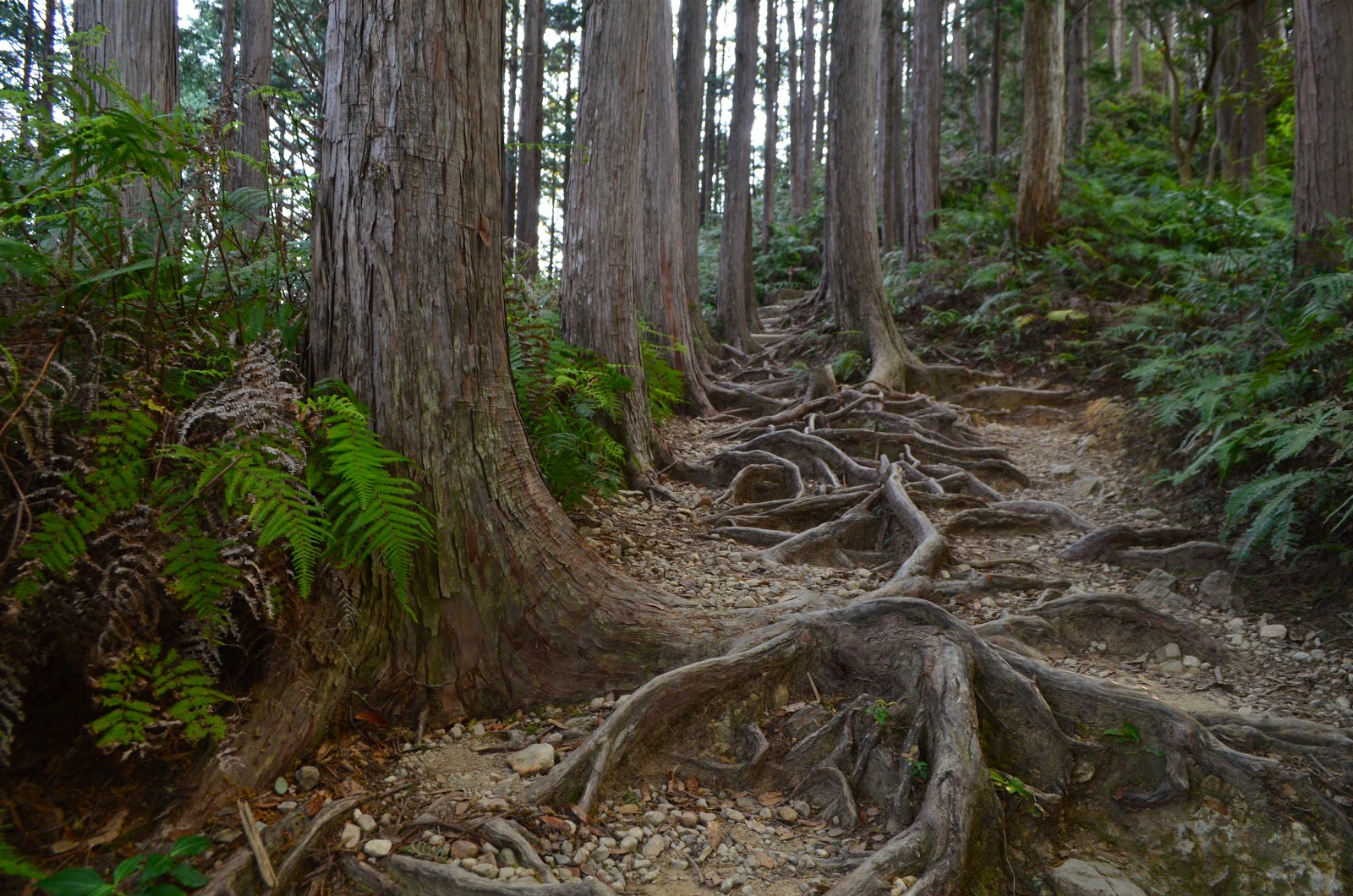
Unlike other hiking trails in Japan, large flat stones cover the Old Kumano Road. For centuries, before modern transportation, people walked the path between the towns of the south and the sacred shrine of Ise Jingu to the north. As I went along the stones underfoot appeared smooth and worn from heavy use. A few other hikers came the opposite way, all of them Japanese people over the age of 50. They politely greeted me with a "Good morning." A few kilometers into the forest the trail peaked and dropped in elevation. A second dirt trail branched off in this spot and led to the top of a mountain. Why not go check it out I thought. This new trail had no stones, and it ascended at a sharp incline. I was sweaty and heavily panting by the time I reached the summit. A large, rocky ledge offered a clear view to the west and southwest. The port city of Owase shone pale yellow in the morning sun. Its myriad of rooftops and grid like roads cut a swath inland between verdant mountains. I took my obligatory photos and then it was back down the mountain. 

Map Post
Way Up
Owase City
Roots
On the way I came upon a man I had overtaken earlier. He was taking a rest. I smiled and said something to the effect of, "Nice morning for a hike eh?"

He agreed. The man was probably in his mid 50s. He said he had come from Owase. That was his hometown, but for the past decade he had been going around the world on a fishing boat.

"The boat's currently docked in Brazil for repairs," he said. "So I thought I'd take the opportunity to visit home. It's been over two years."

From what he told me he was content to hike the Old Kumano Road every morning during his stay, much as he had when he was a boy. Life on a boat afforded no such opportunities, and in spite of visiting ports across all the continents he was seldom granted shore leave.

I shook my head. "What a shame."

"The company I work for is based in Tokyo," he added, as if that explained why it had such a lame, strict policy towards its employees.

As we talked more I asked him what there was to see in Owase.

"Nothing. It's just a fishing port."

That did not discourage me from wanting to see it. Since we were both headed that way I suggested that we walk together.

"I think it best you go ahead alone," he smiled. "I move at a slow pace."

I thought I might take a picture of the man. I asked if that would be okay. He declined with a sideways wave of the hand across the face. "Alright then," I said and hiked on.

The trail descended and the forest eventually cleared. Houses and roads marked the north side of Owase. The Old Kumano Road continued on through the city and into the mountains to the south. I did not care to follow it much further. My plan was to take some photos and then return to my car. I had also wanted to eat at a restaurant. Owase is renowned for the local seafood. It is one of the few places in Japan where they serve grilled sunfish. A friend had once told me the fish is delicious and has the texture of pork. Unfortunately, it was still too early in the day. None of the restaurants were yet open for lunch. Rather than wait I went back into the forest and hills.  The Old Kumano Road was now inundated with hikers and when I reached my car the dirt lot brimmed with vehicles. A local tourism society had also set up an information table nearby.

"You want me to take your picture?" asked one of the staff.

"Yeah, sure."

He handed me an old straw hat. I place it on my head, stood beside the sign that marked the trail, and posed.

I took back my camera. "Here have this too," said the man, giving me a guide pamphlet. Back in my car I flipped through it and discovered that there was a narrow river ravine only a half hour away. Since it was only noon I started up the engine and drove inland.

Port
Beer Vending Machine
Going Back
Done
Under the Water

Spring this year in Japan has been unusually cold. But on this final day of Golden Week, as I went along the river, the warm weather signified a definitive turn for the better. I was so pleased with the change I stripped down to my underwear and slipped into a pool of swirling water. The water was ice cold though. I endured by moving my limbs to generate warmth. On the rocks near the water surface I noticed black tadpoles. They were taking refuge from the currents and basking in the bright midday sun. At the opposite end of the pool two small waterfalls dropped down from a rocky overhang. I swam over and sat lotus style beneath the larger of the two. I was determined to take 100 deep, focused breaths while the frigid water pummeled my head and shoulders. But the attempt ended in failure. I became so light headed that I gave up halfway for fear of fainting.

Tadpoles
Glorious Falls
I don't know what it is with me and waterfalls. Every time I come across one I am tempted to sit or stand beneath it. Perhaps the experience makes me feel like a samurai of old, when they trained in a similar manner.

Whatever the reason I came out of the water at last content with the trip. I sat on the whitewashed rocks and slowly dried off, all the while thinking of nature and its grand majesty. And so ended my excursion south. Once I returned to my car, I drove straight home.

Spring in Japan at Last