Old Republic
When I was a child, halfway across the
world there existed a place called the Soviet Union. It was an
imposing stretch of territory, where for decades, countless souls toiled under the red sun of communism. Then the USSR
tried to take Afghanistan. That misstep precipitated its historic
collapse and in a matter of 10 years the once mighty Soviet empire fragmented at its edges. New countries appeared, many of which
were difficult for the average American to pronounce, and few would have
known one place from another were the names not written on the map. But not me. Even
at the time while I was a middle school student, I adored maps and gazed at
them imagining what wonders each country had hidden away in its
respective blotch of color. It was only a question of time until I
began to find out.
I think Kazakhstan has been the 36th
country I've visited. I say so with some doubt because the meaning of
the word "visit" is open to interpretation. For example,
does going only to an airport constitute a visit? Or how about
spending a few hours in one of the cities? For me, I would say "no"
to the first, and "yes" to the second. Along those lines
of logic, I'm at 36. Number 35 happened to be another former Soviet
republic--Kyrgyzstan. I should be writing about there now and not
Kazakhstan, but my time in Kyrgyzstan is far from over. I'm kind of
leapfrogging around Central Asia while using the latter as my base of
operations, so after I finish seeing the country, I'll write
about it in its entirety. As for now Kazakhstan's my
priority, and with the order of my travel writing clarified, let's
get to it.
 |
| National Flag |
Turkistan
Kazakhstan is a big country (9th
largest in the world). Its cities are sparse in number, separated
by large distances, and considerably different depending on the region. In
the south is Shymkent--nothing interesting--with Turkistan a little
ways up and over. Turkistan has a storied history owing
to its place on the Silk Road, a conduit along which came
more than trade. Islam entered into the region via Arabs on military
campaigns. Later its most prominent advocates were Turkic holy men.
They spread religion in a more peaceful way which appealed to Central
Asia's nomadic tribes. One such man named Yassawi gained favor
in the Kazakh steppes by teaching a kind of folklore Islam. He
eventually settled in the area and after his death, Tamerlane built a
mausoleum in his honor. It still stands today and was why my friend Calvin and I visited the town.
The days were dry and hot in Turkistan, and we had no choice but to endure this unfavorable weather to see the sights. The first place we went to was an
abandoned fort built at a major crossroad on the old Silk Road
routes. It was in the middle of nowhere, very much in ruins, and had
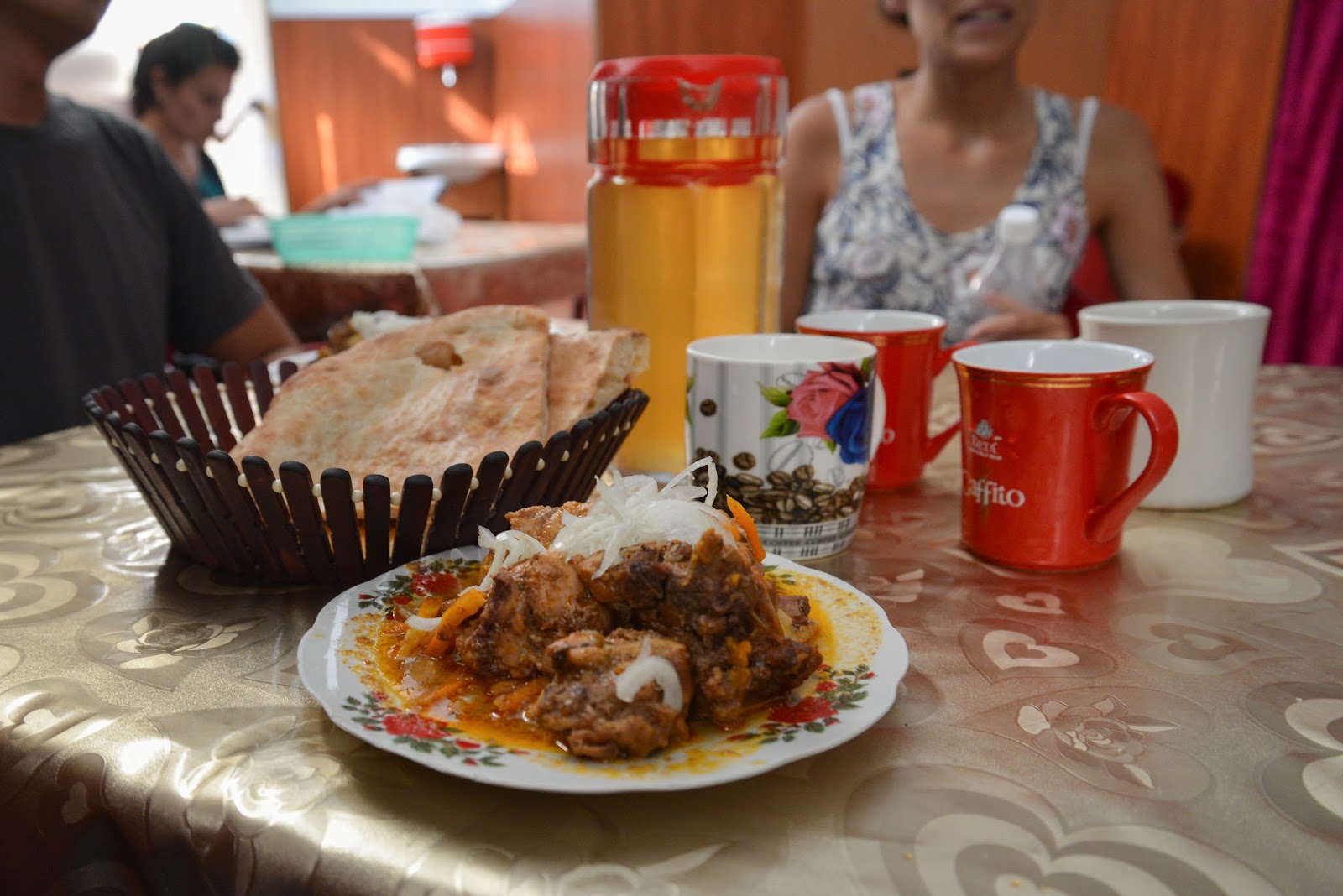
little to see other than bricks and mud walls. Our driver was the most interesting part of the excursion. A former
boxer who had lost his left leg from the knee down, he could still operate a taxi using a cane that he'd duct
taped to the brake and moved with his hand. For a crippled man the
guy was high spirited and friendly. This meant he was also talkative,
and though I understood very little of his Russian, I did my best to
hold up a conversation. As we were cruising along the driver
stopped on the highway and bought watermelons freshly picked from
nearby fields. Later on, after we'd explored the old fort, he carved
one up with a knife from his car. We sat and ate in the shade of a
gazebo while dust swirled and the occasional train barreled past on
nearby tracks. The sweet, juicy pieces of watermelon were an absolute
delight, and moreover, the highlight of the visit. I became terribly bloated from overeating--but in a good, satisfying way.
That same day Calvin and I went to the
Yassawi Mausoleum. It was late in the afternoon and shades of pink
graced its walls. After entering, we walked around the building,
viewing it from every angle. This gave us the chance to take plenty
of photos of the impressive, blue-domed structure and we remained
until dusk. Seeing how the sun set late in summer we didn't start
on dinner until around 9:30pm. The restaurant we visited was one of
the finest in town, complete with an outdoor patio and dance floor in
the middle. We spotted two Dutch girls from our hotel and joined
their table. They'd already finished their food and moved on to
beers. I had one too. It wasn't enough and I ordered more. Then, right as I was starting to feel the effects of the
alcohol, the restaurant closed, as did all other places in town. To
continue the fun we resorted to crashing a wedding reception at a
banquet hall (only after asking the doorman if it
was ok to enter). Many of the guests seemed happy to have us. We
danced with them and drank shots of vodka, but while this was
happening I noticed some ugly stares from a handful of the older guests.
It was understandable considering how we'd arrived uninvited and were underdressed for the occasion. The men had suits on and I was
wearing only a t-shirt and shorts. Eventually, a woman asked us to
leave. We said, "no problem," and ducked out, a little
embarrassed by the situation.
 |
| Sauran Ruins |
 |
| Watermelon Anyone? |
 |
| Happy Camel |
 |
| Yassawi Mausoleum |
 |
| Site Placard |
 |
| Dusk Approaches |
 |
| Friendly Kazakhs |
 |
| Sunrise Over Lake Balkash |
Borat
No discussion of Kazakhstan would be
complete without mention of Sacha Baron Cohen's 2006 film Borat.
The movie features Cohen playing the part of the titular Kazakh who
visits America to create a documentary for his compatriots back home,
hence the subtitle: Cultural Learnings of America for Make Benefit
Glorious Nation of Kazakhstan. What sets Borat apart is
that besides a few key actors, most the people who appeared
in the movie were unaware that the premise of the documentary was a
ruse, and that they were in fact taking part in a comedy which drew
laughs at their expense. A well received film, Borat succeeded
in putting Kazakhstan on the map for the collective American psyche.
But it wasn't done in good taste. After being in Kazakhstan, I can say for certain that Cohen's portrayal didn't resemble a Kazakh man in the slightest. All the cultural quips he made were fabrications, particularly his ongoing phobia of Jews and how they were demonized by Kazakhs. And during
the scenes where he was supposed to be speaking Kazakh, he instead
used Hebrew, while his assistant Azamat spoke Armenian. As if
that weren't enough, Cohen acted out loads of absurd scenes, and for
good measure, a few scatological moments. The result was hilarity at
its best. But as a cultural piece Borat
provides about as much insight into Kazakhstan as Dragon Ball
Evolution does for Japan. So it's understandable that the people
of Kazakhstan became upset when the one thing foreigners began
associating with their country had zero to do with them.
Let's not forget the Romanians either.
At the beginning of the film, Borat gives a tour of his home of
Kuzcek, introducing his sister as a prostitute and the local mechanic
as the town abortionist. Kuzcek, of course, doesn't exist. Filming instead took place outside of Kazakhstan in the Romanian village of Glod. So Cohen falsely
represented yet another group of people and they weren't happy about
it. Some of the villagers went as far as to file an unsuccessful lawsuit against the actor.
But the real joke was not on the Romanians or Kazakhs. It was on
Americans. In a country where 40% of working-age adults have a college degree, Cohen showed how ignorant Americans were when it came to
their understanding of Central Asia. I for one hadn't known anything
at the time of Borat's release, save for the fact that
Kazakhstan was home to the Soviet space program, and that missions
were still launched from the country's Baikonur Cosmodrome, Eurasia's
equivalent of Cape Canaveral. I'd also read that it was the setting
of the Kyzylorda Massacre, where in 1924, Bolshevik Cossacks rounded
up some 400 hundred children, raped and tortured them, then feasted
on their flesh in a manner that terrified the local nomads. It was
all an attempt at psychological warfare, and for the most part
successful, because the Russians soon made large territorial gains in
the region.
American or not, you likely believed
what I just wrote. The Kyzylorda Massacre never happened. It was a fabrication about a place you know little about--its
history even less so. Does this mean you are ignorant or an idiot?
Not at all. The world is a vast place and it's impossible to be
entirely knowledgeable of its geography, varied cultures, colorful
histories, etc. Kazakhstan is but an example that illustrates this.
The Democratic Republic of the Congo is another. Really, how much
does the typical Westerner know about the country? Well, here's some
facts. The population is fast approaching 80 million. Copper and cobalt have become it's principal exports. The capital in Kinshasa. I looked it up now on
Wikipedia. But what I already knew, was that the Belgium monarchy
instituted slavery there between 1882 and 1908. Rubber was the impetus behind this human right's violation. Global demand for it had skyrocketed towards the
end of the 19th century and the Congo basin became the last place
where a European country practiced slavery on a large scale, a fact made scant mention
of in Belgian history books (if included at all). And that's one
story I didn't fabricate. When it came to light, the resulting
scandal became the undoing of King Leopold II's reputation, and
moreover, it damaged the image of European colonialism throughout the
world. Anyhow, my point here is that people don't know much about far
off places so it's easy to fool them into believing anything, which
was what Cohen did in Borat. In truth, he could have filmed
the movie in a dozen other Western countries and the result would
have been similar.
 |
| Film Poster |
Partnership
I've already made mention of Calvin.
He's another traveler who I met through couchsurfing.com. I put up a
general travel notice and he replied saying that he had a similar
time frame for Central Asia. So we met in the Kyrgyz' capital of
Bishkek and then decided to team up and strike out across three
countries: Kyrgyzstan, Kazakhstan and Tajikistan. Things have gone
well since then.
What's so peculiar about our travel
partnership is that Calvin and I are very different from one another.
He is neat and organized; I am sloppy and more of a just wing it
type. Calvin prefers seafood and avoids things like mutton and
cheese. I'm the complete opposite there. But perhaps the biggest
divide between us is that I drink and dance, and he does neither. I
usually end up doing double of both to compensate. Ok. That's a lie.
I party for the love of partying. Yet it fills a gap that Calvin
couldn't do on his own. And in ways like this we compliment one
another. For example, it helps too that he has a smart phone. How I'd
gotten by without one while traveling is now beyond me. Offline
google maps with GPS positioning alone is a godsend. No longer must I
keep asking for directions like I had before. Yet we still ask people
something when unclear about what's going on, and in that regard
Calvin is more proactive than I am. I suppose I'm a bit shy when it
comes to approaching strangers. Either that or I prefer to figure out
a solution on my own.
Anyhow, when traveling there's a lot of
downtime. I'm referring to long bus rides, a rest in a park, idle
talk after a meal at a restaurant. When me and Calvin are alone like
this, he makes for a good conversationalist. Much of it has to do
with how his life experiences are entirely removed from mine. Calvin
grew up in a large urbanized city, himself a Singaporean of Chinese
descent. As a Hispanic, my childhood was spent in San Diego in a
quiet neighborhood surrounded by nature. His background is in
banking, mine in teaching. What it amounts to is us seeing the world
through very different lenses. In Singapore life is about status and
getting a high paying job to lead a comfortable lifestyle, and in
some respects Calvin buys into that. For me though, a job is not a
solid indicator of a person's worth or purpose. Quite to the
contrary, I see the entire working-to-live-scheme as the trappings of
a society which guarantees nothing in return for our compliance. It's
a sad and mostly unescapable situation, but as with anything else, if
there's a will there's a way out. I think Calvin too has a sense of
this. The problem is breaking free from the rigidness of the
Singaporean mold is no simple task. I believe he's still trying
though. Rather than build up material wealth Calvin's investing in
personal experience and the lessons learned through travel. Then
again, I may be reading too much into his behavior.
The real focus here should be on how
happy I am to finally have a long-term travel buddy. In the past I
had to confront the world alone. Now I do it with Calvin. Aside from
having someone to talk to avoid the general ennui associated with
single travel, I also share costs which saves us both money.
A taxi ride is a good example of this. Instead of paying the fare
alone, we split it 50-50. Or at a hotel, by staying in a double
room, we end up paying less per person than if we were to each stay
in a single room. In a developed country like Kazakhstan our
partnership resulted in some serious savings. Calvin is also more of
a haggler than I am (probably because of his Chinese blood) and this
too meant I was spending less money in the long run. With an app
called Monefy, he keeps tabs on our expenses and knows who owes who what down to the smallest
denomination. Little wonder he enjoyed working before as a personal
banker.
Astana
The capital of Kazakhstan, Astana, goes
by the most literal name possible. In the Kazakh language it means
"the capital." Formerly known as Akmola it was renamed in
1998 after President Nursultan Nazarbayev made it Kazakhstan's new
capital, moving the location 1200km north of where it'd been before
in Almaty. His reasoning was that the region is less prone to
earthquakes. In reality though, he needed to assert more control over
the northern part of the country which was composed predominately of
ethnic Russians. In the following years city planners got to work
erecting flashy buildings beginning with the Bayeterek Tower and then
other modern marvels that stretched out along a concourse in the city
center. Cranes continue to piece together more and more
buildings, most of which are laden in blue or gold window panes. The
money comes from the proceeds of
Kazakhstan's oil and gas industries. Rich in natural resources, the
country has buyers lining up to pay good money for a
cut of the export supply, Russia, Italy and China to name a few.
Business is good in Astana. In the
years since becoming the capital, it's seen its population quadruple.
Even so, the city still has under a million people, so while I
visited I didn't feel I was in a bustling metropolis. But like a
large metropolis it was expensive. A dorm bed in hostel cost Calvin
and me $14 each and we were lucky to find a sit down meal under $5.
Having to deal with these prices it didn't take long for us to go
over our travel budget. However, rather than worry about money we
accepted our situation and made the most of the visit. First we saw
the sights, including the Khan Shatyr , a shopping mall housed within
a giant tent. At the very top was a beach-like pool with sand brought
in from the Maldives. We didn't go in but were still impressed it
existed in such a place. I later read that the facility is maintained
at a constant 35°C year
round. Considering that Astana can drop to -50°C,
the beach certainly provides a nice reprieve from the cold in winter.
Later we walked down the concourse and went up the Bayeterek Tower,
a symbol of the nation that is on many of the currency notes. When
President Nazarbayev held a ceremony for its grand opening, he had a
print of his palm created for the occasion. Now hundreds of people
line up daily to place their hand in the spot and get their picture
taken. I too lined up not knowing what for, then became disappointed
to find it'd been for this reason.
With Astana being an expensive place,
Calvin and I had the good sense to put in requests on
counchsurfing.com beforehand. Our efforts led to us staying with a
Polish guy for three of the four nights we spent in the city. We
arrived at his one bed room apartment, and since space was limited,
Clavin and I used our mats to sleep on. The host, Wictor, told us
he'd moved to Astana to do an internship at the Polish Embassy. In
university his major had been political science and he knew a great
deal about the geopolitical situation in Central Asia. We discussed
much over beer and vodka. I learned that Kazakhstan is divided up
into regions dominated by members from three different groups. In the
north and east are the Middle Tribes who are the most urbanized. Then
in the south there are the Greater Tribes who trace their lineage
back to history's most influential Turkic and Mongol khans. Lastly,
in the west exist the Smaller Tribes. For ethnic Kazakhs a good
family name can hold more importance than wealth, a tribalist aspect
of society that influences the attitudes of people in their every day
lives. But no where is it more felt than in politics and military postings. President Nazarbayev, for example, came from a
modest background in terms of money, but he hailed from one of the
Greater Tribes and could still rise to the highest ranks of
government.
 |
| Bayterek Tower |
 |
| Yes, I do |
 |
| Wictor, Calvin and Me |
 |
| Office Building and Statue |
 |
| View from Bayterek Tower |
 |
| City Skyline |
 |
| Orthodox Catholic Artwork |
 |
| From Outside |
 |
| Central Asia's Largest Mosque |
 |
| Doves of Peace |
Survival Russian
Once in Central Asia, one thing that
becomes painfully clear is the lack of English proficiency among
locals. Few people in the big cities speak it, and in the countryside
it's near non-existent. In place of English, they speak Russian as a
second language. In urban areas some even speak it as their first and
are limited in their ability to use Kazakh or other regional
languages. I'd heard as much before heading in and decided to learn
some Russian to better communicate. I began with the Cyrillic writing
system while still in India. I wrote the characters into a small
notebook and their phonetic pronunciations. Then came the stock
phrases: "My name is Phil," "I'm from America,"
and so on. Weeks later when I arrived in Central Asia, the phrases
did me little good. Who cares if someone knows what my name is, when
the my real priority is figuring out how to catch a bus from the
airport to town?
Learning Russian at even a
conversational level was never going to happen, and I knew it. But as
the weeks passed I picked up what was needed to haggle at a market,
order food from a restaurant, tell a taxi driver where I wanted to
go, buy a bus ticket, and more. Survival Russian equated to this. And
still it was not enough. I realized there was always something more
to learn. For one, I felt a genuine desire to explain myself to
locals--to let them know who I was and why I'd come to their country.
Language was the main way to get that information across. However,
the barrier I had to overcome couldn't have been worse. Russian is
nothing like English. It has Slavic roots with words that could mean
anything. Moreover, the grammar is complex, in that verbs conjugate
differently depending on the subject of a sentence and its tense.
Each verb ends up with over a dozen forms. Even nouns have different
suffixes to signify their purpose in a sentence and how they match up
with prepositions. I couldn't be bothered to memorize all the rules,
so I approximated as best I could, speaking with crude, limited
grammar.
What amazes me is how effective my Russian caveman talk has been. If I were to say in
English, "In America, like pizza. Here no pizza. I sad," I
would come across as a little strange, but still understood. Now lets
make it more complex: "Before this two year in America, I have
wife. It no good. Now no wife. Later, new wife, maybe. No problem."
Again, the meaning is still clear. And these are things I can say in
Russian. Throw in some added gestures and even more information
becomes conveyable. The problem is having the vocabulary. Had I been
smart I could have focused on learning words from the beginning but I took a
lazy approach. I just made it a point to write a few words
every now and then. On the upside I still fared much better at
learning than most the tourists I met. Perhaps they thought the
prospect too overwhelming and didn't make much an effort to begin
with. Calvin was this way. And he had me to rely on. The funny thing
is he looks very Central Asian, so of the two of us, locals often addressed him first. At the same time
Calvin did download a Russian language package for Google Translate
on his phone. As an extension of that Google could use his phone's
built in camera to translate text in real time, showing the English
on the phone's screen, but only when we had an Internet connection.
Technology. It never fails to amaze.
 |
| Posted Notices |
 |
| Sometimes English is Best |
Facebook
I'll be honest. I have a serious
love-hate relationship with facebook. To begin with, a social network
of any kind provides only a glimpse into the lives of people, one
that is distorted by what users choose for others to
see. By its very nature the site is largely unauthentic in how profiles are presented. Then you have the shameless self promoters, the whiners, the
attention-whores, the agenda seekers and so on. Because users are able to hide behind a screen, it's easy to let it bring out the
worst in their tendencies. I too am guilty at times, I admit. But for
the most part, if I have nothing of interest to share I refrain from
posting. So I upload photos every other week, leave status updates
even less frequently, and sometimes chat with friends. The chatting
is done privately on account of me feeling it's not anyone else's
business what I discuss. That's not to say I'm chatting about lurid,
secretive things, but rather, I think most people would not find any
of my discussions relevant, so why make them open to the public? To
my dismay, some people choose to do this anyway, spouting out all
manner of things in long comment threads.
Anyhow, the thing I find most annoying
about facebook is the frequency with which I check it. I'm traveling
now and can't always use the Internet, but when I do have good
access, I'm on the site 10 times a day or more. It's mostly me
lurking around without saying anything. And what for? To see what
other people are doing, to click on the articles friends have linked
on their profile, to pass the time. In this regard I suppose I'm the
same as everyone else. I only wish I could take a more detached
approach and limit my usage. It would free me up to focus on more
creative tasks such as writing, taking photos, or simply interacting
with others--face to face. Above all else, that's what gets me. How
I'm surrounded by living, breathing people, but rather than talk to
them, I'm plugged into the Internet. And it's worse considering how
at this time in my life these people are interesting backpackers from
around the world. At this moment I'm at a hostel and
there're Israelis, Germans, Czechs and so forth. But earlier I was
using facebook (among other sites), closed off to everyone, the same
as now.
It's not all bad. By using
facebook I can stay connected with people regardless of where
I am. This is probably why I'm so active now. Being on the road is
more difficult than people think. At times I feel as if I have no
home, no roots--I'm simply flotsam on an ever shifting sea--and then
I log into facebook and see a message from a friend and my day
brightens. Or it could be that I see a photo of someone doing well.
Maybe they got married, had a positive job interview, met a girl.
I've heard before that facebook evokes feelings of jealousy and
inadequacy seeing how some people think their lives don't measure up.
But for me, those feelings are either entirely absent, or merely
minor and fleeting. The truth is, I'm happy for others when
their life is going well, and conversely, I empathize if things are
bad. I just don't like it when people try too hard to impress, or
worse, drag others into their hole of self loathing and misery. At
any rate, facebook is what it is, and I believe for better or worse
it's here to stay.
Almaty
The largest city in Kazakhstan is its
former capital Almaty. Rising high on the city's southern horizon,
the peaks of the Trans-Ili Alatau mountains reach over 3000m. Many of
which have glaciers flowing between them, and since it was something
to do, Calvin and I went up by gondola to take a closer look. The
route had three stages. We had to get off each time to transfer to
another gondola, and at the end a grassy valley straddled the
uppermost peaks on the one side, while opposite it, a sharp descent
down offered an equally impressive view. Some families had arrived
with food to have a picnic. I noticed two young girls picking
wildflowers and took photos. Their father waved me over, then offered
me a chunk of horse meat followed by a shot of vodka. The alcohol I
didn't want but still accepted out of politeness. The moment I
threw it back, it caught in my throat. I let out a deathly cough.
Tears welled in my eyes. I heaved for air. The Kazakh man laughed and
made to pour another. "No thank you," I said in
Russian. One shot was enough.
In a big city like Almaty, Calvin and I
needed to couchsurf again to save on expenses. We ended up at the home of two
Kazakh men, Sergey and Stanislav. European in appearance their names matched their look. It wasn't unusual for Kazakhstan. People of the sort were quite common
throughout Central Asia, especially in the cities, the descendants of
settlers that had moved in after the Russians took control of the
region. At any rate, our hosts had a room ready for our use, prepared a nice dinner and talked with us over tea. They also had two
cats, including a kitten named Tom. As adorable as he was, Tom had a
bad attitude and didn't like being held for long. But he still craved
attention. He would come up and paw at my feet while we sat around
the kitchen table. Speaking of which, one night I prepared Mexican
food for my hosts. First we had to go to the supermarket to buy
ingredients. I got chicken breast, vegetables, and even found sour
cream. As for the tortillas, I had to improvise. I used a kind of flat
bread they sold in large sheets, then cut out circles using a bowl as
a template. Lastly, for hot sauce I found some cheap Chinese stuff in
a plastic bottle. Though the taste was completely off the tacos were
better with it than without.
Some 150km east of Almaty where the
mountains give way to dry, endless steppes, we went to a national
park called Sharyn Canyon. The locals referred to it as the Grand
Canyon of Kazakhstan. I can't say it lived up to the title, but it
was still worth visiting. A shared taxi got us as far as the
park's entry road. At this junction we met a tour guide from Belarus.
He was guiding a caravan of Germans through Central Asia and had set
out early to do some reconnaissance of the area. We asked if he could
give us a lift to the canyon's trailhead and he was happy to take us
in his van. On the 10km dirt road, we then came across a pair of Russian
women that had given up trying to walk, and in they came. After we
made it to the trailhead, we hiked down a path that followed the
canyon floor. To both sides layered sandstone rose in all manner of
shape. Rocks had fallen here and there, and sparse vegetation added
to the scenery. About an hour in we came to a river. There were some
Kazakh tourists playing in the water and taking photos. Two of the
younger ones spoke good English. They were happy to meet an American and said they wanted to travel to my city one day. I've heard the
same before knowing it's an impossibility for the locals. But Kazakhstan is different. Contrary to what Westerners think it's a developed
country with people who have money to go overseas.
On a final note, I was surprised that
any Kazakh with a car could double as a taxi driver. This was most
common in Almaty, and when Calvin and I needed a ride it didn't take
long for a random person to pull over for us. Of course we had to pay
to go anywhere, but it still seemed strange getting places in this
manner. Everyone did it though, including single young females late
at night. In America no one in their right mind would get into a car
with a stranger, especially women. So I guess it goes to show
how safe Kazakhstan is. I for one never felt threatened while in the
country. There was only the problem of the police. From what I'd read
on the Internet they were apt to harass foreign tourists for money. But I
never got extorted in this way. Perhaps it was because I avoided any
policemen I saw, often ducking into a side street if necessary. They
were easy to spot thanks to their large soviet-era style hats.
 |
| Gondola Ride Up |
 |
| Glacier |
 |
| Hungry Butterfly |
 |
| Plenty of Wildflowers |
 |
| Almaty's Zenkov Cathedral |
 |
| Taco Stuff |
 |
| Posing for a Photo |
 |
| Sharyn Canyon |
Lakeside Fun
For our final days in Kazakhstan,
Calvin and I decided to do some camping in the mountains, and after
contemplating our options, we went to Lake Issyk 90km southwest of
Almaty. Due to its close proximity to the city the lake was a popular
weekend spot, and when we arrived on a Saturday, a hundred or so
people were already scattered around the shore. While searching for a
place to camp we found a group of youngsters who had
already put up tents. They said hi and invited us to
join their circle. Half the group was Kazakh. The rest were expats
working in Almaty with one guy from India and the others out of
Europe. We sat drinking tea, playing cards and
then helped start up the grill. In Kazakhstan shashlik is how the locals
like their meat. It's basically chunks or raw meat on skewers cooked
over an open flame. At restaurants it's not uncommon for workers to use a hair dryer to get the coals hot, but at our campsite we
didn't have this luxury so the task involved a lot of
blowing. To go with the meat the group had brought watermelon, bread,
candies and most importantly, beer. It was good ole Kazakh
hospitality. They shared everything and asked nothing in
return.
As night drew near, we made a campfire
and gathered around to tell spooky stories. One of the local girls
swore that her cousin had seen a ghost during a visit. The ghost was
of a young bride standing on the water. The way the story went, a
family had been holding a wedding at the lake on July 7, 1963, a
fateful day when a huge mud flow came sweeping down from the
mountains and took Issyk Dam with it. Hundreds more died as the disaster spread downhill to Issyk Town. It
wasn't until several years after that the area was repaired and
people returned to enjoy the beautiful nature. Anyhow, I too wanted
to share a story but didn't know any except for yanagi onna,
a Japanese folktale about a woman who died beneath a willow tree.
According to the tale, whenever the wind now blows through one, a person can hear her crying. I don't think anyone found any of this scary, but at least I could share some Japanese culture.
Later I was trying to explain about marshmallows and how in American we like to roast them on a stick when around a fire. At that point the
Europeans had gone to bed, and the remaining Kazakhs had no idea what
I was talking about. "They're white, mushy candy things that you
can kind of burn," I tried to explain again. "You know? In
the shape of a cylinder." Such words failed to make the picture
any clearer in their heads and I gave up.
The following morning the group rolled
up their tents and sleeping bags to take them to the parking lot and put in their cars. Me and Calvin, who were staying another night,
left our stuff in place. But it wasn't yet time to say goodbye. We had it
in mind to take a hike, and conveniently enough, a park ranger
agreed to guide us to the site of a cave. We first made our way up a
river valley that fed into the lake. Along the trail we saw
wildflowers and raspberry bushes, then came to a tall barrier built
over the river. The park ranger explained that it was there to weaken
a future mud flow and prevent a repeat of the 1963 disaster. To get to the cave we needed to cross on a shoddily
constructed catwalk. I felt a bit of vertigo looking down at the
welded poles and wide gaps beneath my feet. On the opposite side our trail vanished between trees
and thick undergrowth. "Now no way through," the ranger
said, and back we turned without seeing the cave. I wasn't
disappointed. The hike had been a lovely outing, though afterwards, I was sad to say goodbye to our new friends. In the afternoon I decided to go for a swim in the lake. When I came out I met another group of Kazakhs. They too gave us more food than we could eat, and one of the guys--already loaded up on vodka--offered to
take me hunting for deer later in the week. I politely declined. Once it got dark Calvin and I retreated to our tent to watch movies. The trip to the lake would have ended perfectly had I
not swallowed a bit of the water while swimming earlier. Only
afterwards did I notice some brown foam floating on the surface, and
sure enough, I awoke the next day with an upset stomach. By noon I
was scrambling for the nearest toilet. Oh, the woes of the traveler's
life.
 |
| Issyk Lake |
 |
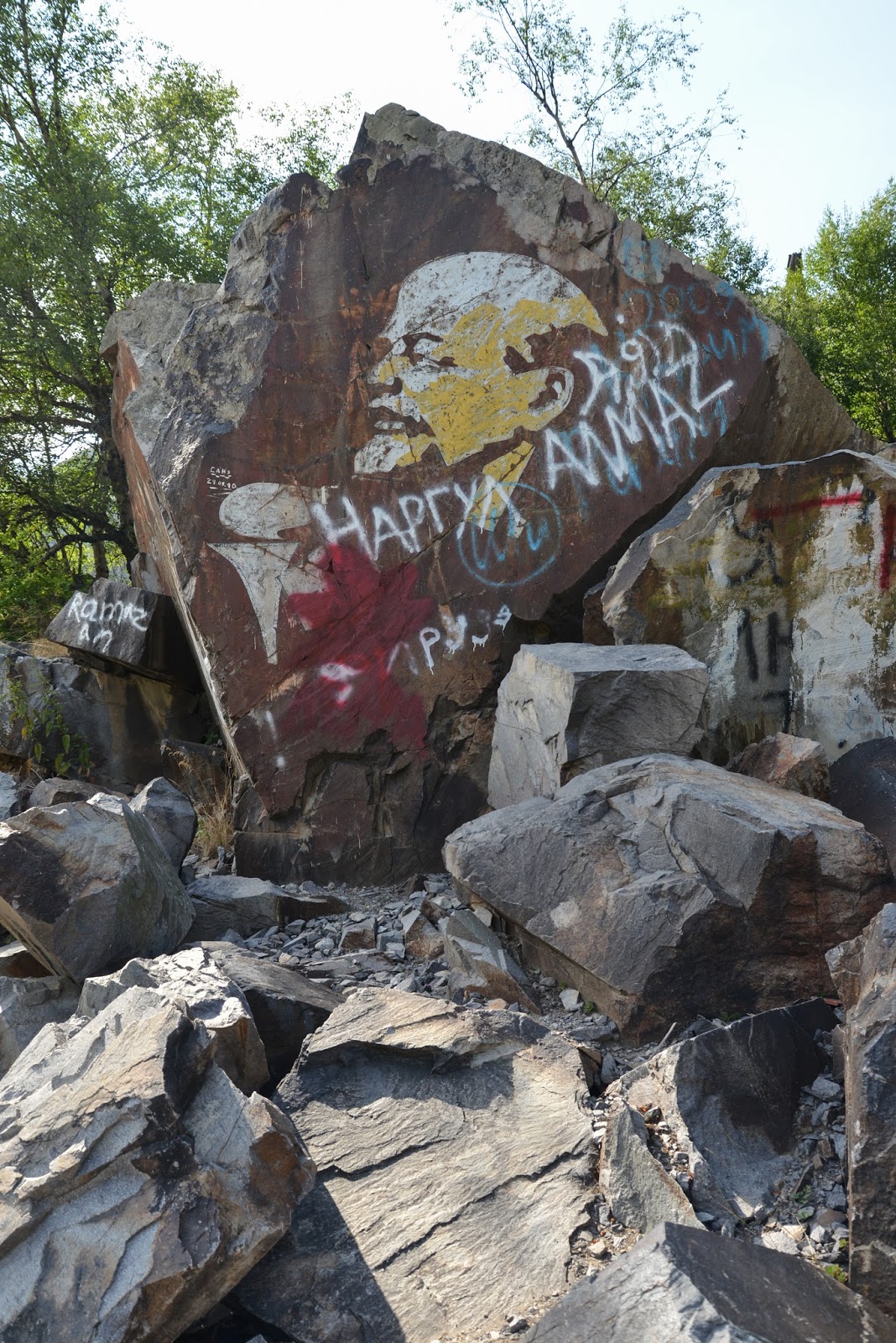
| Communist Graffiti |
 |
| Card Game |
 |
| Shashlik |
 |
| Playing with Campfire |
 |
| Across the Barrier |
 |
| Pretty Flowers |
In Conclusion
Calvin's and my stay in Kazakhstan was
a short one--only two weeks. I might have stuck around longer had my
passport allowed it, but my entry stamp gave only 15 days and an extension would have required a proper paid visa. It was probably for the best we left sooner than later. Traveling in
Kazakhstan had cost much more than expected. So from Issyk
Lake we returned directly to Bishkek in adjacent Kyrgyzstan. It was right
opposite the border from Kazakhstan yet everything was immediately cheaper. What a relief, we thought and breathed easy knowing our cash
would stretch further. We were also happy to return to the same hostel we had stayed at before with its nice garden and good wi-fi connection.
If I have any lasting impression of Kazakhstan its that the country is large and mostly flat. For example, on our 20-hour bus ride from Astana to Almaty the view to either side was of yellow steppes interrupted only by the occasional rise of mountains in the distance. It did not change until at the very end in the greener south. Anyhow, these were the same steppes the Mongols had crossed en route to their great conquests of the13th century. Without any natural barriers to block their passage they wreaked havoc as far as the Middle East and Eastern Europe. Over the centuries Kazakhstan has seen several such empires rise and fall, and each has left a lasting mark ending with the Soviets. Now that the country is independent, where it goes from here is anyone's guess. Blessed with natural resources it would seem a bright future lies on the horizon but government corruption and strong traditions stand in the way of progress. Only time will tell.
 |
| Cows on the Steppes |