Monday, August 10, 2015

On the Road: Kazakhstan

Old Republic

When I was a child, halfway across the world there existed a place called the Soviet Union. It was an imposing stretch of territory, where for decades, countless souls toiled under the red sun of communism. Then the USSR tried to take Afghanistan. That misstep precipitated its historic collapse and in a matter of 10 years the once mighty Soviet empire fragmented at its edges. New countries appeared, many of which were difficult for the average American to pronounce, and few would have known one place from another were the names not written on the map. But not me. Even at the time while I was a middle school student, I adored maps and gazed at them imagining what wonders each country had hidden away in its respective blotch of color. It was only a question of time until I began to find out.

I think Kazakhstan has been the 36th country I've visited. I say so with some doubt because the meaning of the word "visit" is open to interpretation. For example, does going only to an airport constitute a visit? Or how about spending a few hours in one of the cities? For me, I would say "no" to the first, and "yes" to the second. Along those lines of logic, I'm at 36. Number 35 happened to be another former Soviet republic--Kyrgyzstan. I should be writing about there now and not Kazakhstan, but my time in Kyrgyzstan is far from over. I'm kind of leapfrogging around Central Asia while using the latter as my base of operations, so after I finish seeing the country, I'll write about it in its entirety. As for now Kazakhstan's my priority, and with the order of my travel writing clarified, let's get to it.
National Flag
Turkistan

Kazakhstan is a big country (9th largest in the world). Its cities are sparse in number, separated by large distances, and considerably different depending on the region. In the south is Shymkent--nothing interesting--with Turkistan a little ways up and over. Turkistan has a storied history owing to its place on the Silk Road, a conduit along which came more than trade. Islam entered into the region via Arabs on military campaigns. Later its most prominent advocates were Turkic holy men. They spread religion in a more peaceful way which appealed to Central Asia's nomadic tribes. One such man named Yassawi gained favor in the Kazakh steppes by teaching a kind of folklore Islam. He eventually settled in the area and after his death, Tamerlane built a mausoleum in his honor. It still stands today and was why my friend Calvin and I visited the town.

The days were dry and hot in Turkistan, and we had no choice but to endure this unfavorable weather to see the sights. The first place we went to was an abandoned fort built at a major crossroad on the old Silk Road routes. It was in the middle of nowhere, very much in ruins, and had little to see other than bricks and mud walls. Our driver was the most interesting part of the excursion. A former boxer who had lost his left leg from the knee down, he could still operate a taxi using a cane that he'd duct taped to the brake and moved with his hand. For a crippled man the guy was high spirited and friendly. This meant he was also talkative, and though I understood very little of his Russian, I did my best to hold up a conversation. As we were cruising along the driver stopped on the highway and bought watermelons freshly picked from nearby fields. Later on, after we'd explored the old fort, he carved one up with a knife from his car. We sat and ate in the shade of a gazebo while dust swirled and the occasional train barreled past on nearby tracks. The sweet, juicy pieces of watermelon were an absolute delight, and moreover, the highlight of the visit. I became terribly bloated from overeating--but in a good, satisfying way.

That same day Calvin and I went to the Yassawi Mausoleum. It was late in the afternoon and shades of pink graced its walls. After entering, we walked around the building, viewing it from every angle. This gave us the chance to take plenty of photos of the impressive, blue-domed structure and we remained until dusk. Seeing how the sun set late in summer we didn't start on dinner until around 9:30pm. The restaurant we visited was one of the finest in town, complete with an outdoor patio and dance floor in the middle. We spotted two Dutch girls from our hotel and joined their table. They'd already finished their food and moved on to beers. I had one too. It wasn't enough and I ordered more. Then, right as I was starting to feel the effects of the alcohol, the restaurant closed, as did all other places in town. To continue the fun we resorted to crashing a wedding reception at a banquet hall (only after asking the doorman if it was ok to enter). Many of the guests seemed happy to have us. We danced with them and drank shots of vodka, but while this was happening I noticed some ugly stares from a handful of the older guests. It was understandable considering how we'd arrived uninvited and were underdressed for the occasion. The men had suits on and I was wearing only a t-shirt and shorts. Eventually, a woman asked us to leave. We said, "no problem," and ducked out, a little embarrassed by the situation.
Sauran Ruins
Watermelon Anyone?
Happy Camel
Yassawi Mausoleum
Site Placard
Dusk Approaches
Friendly Kazakhs
Sunrise Over Lake Balkash
Borat

No discussion of Kazakhstan would be complete without mention of Sacha Baron Cohen's 2006 film Borat. The movie features Cohen playing the part of the titular Kazakh who visits America to create a documentary for his compatriots back home, hence the subtitle: Cultural Learnings of America for Make Benefit Glorious Nation of Kazakhstan. What sets Borat apart is that besides a few key actors, most the people who appeared in the movie were unaware that the premise of the documentary was a ruse, and that they were in fact taking part in a comedy which drew laughs at their expense. A well received film, Borat succeeded in putting Kazakhstan on the map for the collective American psyche. But it wasn't done in good taste. After being in Kazakhstan, I can say for certain that Cohen's portrayal didn't resemble a Kazakh man in the slightest.  All the cultural quips he made were fabrications, particularly his ongoing phobia of Jews and how they were demonized by Kazakhs. And during the scenes where he was supposed to be speaking Kazakh, he instead used Hebrew, while his assistant Azamat spoke Armenian. As if that weren't enough, Cohen acted out loads of absurd scenes, and for good measure, a few scatological moments. The result was hilarity at its best. But as a cultural piece Borat provides about as much insight into Kazakhstan as Dragon Ball Evolution does for Japan. So it's understandable that the people of Kazakhstan became upset when the one thing foreigners began associating with their country had zero to do with them.

Let's not forget the Romanians either. At the beginning of the film, Borat gives a tour of his home of Kuzcek, introducing his sister as a prostitute and the local mechanic as the town abortionist. Kuzcek, of course, doesn't exist. Filming instead took place outside of  Kazakhstan in the Romanian village of Glod. So Cohen falsely represented yet another group of people and they weren't happy about it. Some of the villagers went as far as to file an unsuccessful lawsuit against the actor. But the real joke was not on the Romanians or Kazakhs. It was on Americans. In a country where 40% of working-age adults have a college degree, Cohen showed how ignorant Americans were when it came to their understanding of Central Asia. I for one hadn't known anything at the time of Borat's release, save for the fact that Kazakhstan was home to the Soviet space program, and that missions were still launched from the country's Baikonur Cosmodrome, Eurasia's equivalent of Cape Canaveral. I'd also read that it was the setting of the Kyzylorda Massacre, where in 1924, Bolshevik Cossacks rounded up some 400 hundred children, raped and tortured them, then feasted on their flesh in a manner that terrified the local nomads. It was all an attempt at psychological warfare, and for the most part successful, because the Russians soon made large territorial gains in the region.

American or not, you likely believed what I just wrote. The Kyzylorda Massacre never happened. It was a fabrication about a place you know little about--its history even less so. Does this mean you are ignorant or an idiot? Not at all. The world is a vast place and it's impossible to be entirely knowledgeable of its geography, varied cultures, colorful histories, etc. Kazakhstan is but an example that illustrates this. The Democratic Republic of the Congo is another. Really, how much does the typical Westerner know about the country? Well, here's some facts. The population is fast approaching 80 million. Copper and cobalt have become it's principal exports. The capital in Kinshasa. I looked it up now on Wikipedia. But what I already knew, was that the Belgium monarchy instituted slavery there between 1882 and 1908. Rubber was the impetus behind this human right's violation. Global demand for it had skyrocketed towards the end of the 19th century and the Congo basin became the last place where a European country practiced slavery on a large scale, a fact made scant mention of in Belgian history books (if included at all). And that's one story I didn't fabricate. When it came to light, the resulting scandal became the undoing of King Leopold II's reputation, and moreover, it damaged the image of European colonialism throughout the world. Anyhow, my point here is that people don't know much about far off places so it's easy to fool them into believing anything, which was what Cohen did in Borat. In truth, he could have filmed the movie in a dozen other Western countries and the result would have been similar.
Film Poster
Partnership

I've already made mention of Calvin. He's another traveler who I met through couchsurfing.com. I put up a general travel notice and he replied saying that he had a similar time frame for Central Asia. So we met in the Kyrgyz' capital of Bishkek and then decided to team up and strike out across three countries: Kyrgyzstan, Kazakhstan and Tajikistan. Things have gone well since then.

What's so peculiar about our travel partnership is that Calvin and I are very different from one another. He is neat and organized; I am sloppy and more of a just wing it type. Calvin prefers seafood and avoids things like mutton and cheese. I'm the complete opposite there. But perhaps the biggest divide between us is that I drink and dance, and he does neither. I usually end up doing double of both to compensate. Ok. That's a lie. I party for the love of partying. Yet it fills a gap that Calvin couldn't do on his own. And in ways like this we compliment one another. For example, it helps too that he has a smart phone. How I'd gotten by without one while traveling is now beyond me. Offline google maps with GPS positioning alone is a godsend. No longer must I keep asking for directions like I had before. Yet we still ask people something when unclear about what's going on, and in that regard Calvin is more proactive than I am. I suppose I'm a bit shy when it comes to approaching strangers. Either that or I prefer to figure out a solution on my own.

Anyhow, when traveling there's a lot of downtime. I'm referring to long bus rides, a rest in a park, idle talk after a meal at a restaurant. When me and Calvin are alone like this, he makes for a good conversationalist. Much of it has to do with how his life experiences are entirely removed from mine. Calvin grew up in a large urbanized city, himself a Singaporean of Chinese descent. As a Hispanic, my childhood was spent in San Diego in a quiet neighborhood surrounded by nature. His background is in banking, mine in teaching. What it amounts to is us seeing the world through very different lenses. In Singapore life is about status and getting a high paying job to lead a comfortable lifestyle, and in some respects Calvin buys into that. For me though, a job is not a solid indicator of a person's worth or purpose. Quite to the contrary, I see the entire working-to-live-scheme as the trappings of a society which guarantees nothing in return for our compliance. It's a sad and mostly unescapable situation, but as with anything else, if there's a will there's a way out. I think Calvin too has a sense of this. The problem is breaking free from the rigidness of the Singaporean mold is no simple task. I believe he's still trying though. Rather than build up material wealth Calvin's investing in personal experience and the lessons learned through travel. Then again, I may be reading too much into his behavior.

The real focus here should be on how happy I am to finally have a long-term travel buddy. In the past I had to confront the world alone. Now I do it with Calvin. Aside from having someone to talk to avoid the general ennui associated with single travel, I also share costs which saves us both money. A taxi ride is a good example of this. Instead of paying the fare alone, we split it 50-50. Or at a hotel, by staying in a double room, we end up paying less per person than if we were to each stay in a single room. In a developed country like Kazakhstan our partnership resulted in some serious savings. Calvin is also more of a haggler than I am (probably because of his Chinese blood) and this too meant I was spending less money in the long run. With an app called Monefy, he keeps tabs on our expenses and knows who owes who what down to the smallest denomination. Little wonder he enjoyed working before as a personal banker.

Astana

The capital of Kazakhstan, Astana, goes by the most literal name possible. In the Kazakh language it means "the capital." Formerly known as Akmola it was renamed in 1998 after President Nursultan Nazarbayev made it Kazakhstan's new capital, moving the location 1200km north of where it'd been before in Almaty. His reasoning was that the region is less prone to earthquakes. In reality though, he needed to assert more control over the northern part of the country which was composed predominately of ethnic Russians. In the following years city planners got to work erecting flashy buildings beginning with the Bayeterek Tower and then other modern marvels that stretched out along a concourse in the city center. Cranes continue to piece together more and more buildings, most of which are laden in blue or gold window panes. The money comes from the proceeds of Kazakhstan's oil and gas industries. Rich in natural resources, the country has buyers lining up to pay good money for a cut of the export supply, Russia, Italy and China to name a few.

Business is good in Astana. In the years since becoming the capital, it's seen its population quadruple. Even so, the city still has under a million people, so while I visited I didn't feel I was in a bustling metropolis. But like a large metropolis it was expensive. A dorm bed in hostel cost Calvin and me $14 each and we were lucky to find a sit down meal under $5. Having to deal with these prices it didn't take long for us to go over our travel budget. However, rather than worry about money we accepted our situation and made the most of the visit. First we saw the sights, including the Khan Shatyr , a shopping mall housed within a giant tent. At the very top was a beach-like pool with sand brought in from the Maldives. We didn't go in but were still impressed it existed in such a place. I later read that the facility is maintained at a constant 35°C year round. Considering that Astana can drop to -50°C, the beach certainly provides a nice reprieve from the cold in winter. Later we walked down the concourse and went up the Bayeterek Tower, a symbol of the nation that is on many of the currency notes. When President Nazarbayev held a ceremony for its grand opening, he had a print of his palm created for the occasion. Now hundreds of people line up daily to place their hand in the spot and get their picture taken. I too lined up not knowing what for, then became disappointed to find it'd been for this reason.

With Astana being an expensive place, Calvin and I had the good sense to put in requests on counchsurfing.com beforehand. Our efforts led to us staying with a Polish guy for three of the four nights we spent in the city. We arrived at his one bed room apartment, and since space was limited, Clavin and I used our mats to sleep on. The host, Wictor, told us he'd moved to Astana to do an internship at the Polish Embassy. In university his major had been political science and he knew a great deal about the geopolitical situation in Central Asia. We discussed much over beer and vodka. I learned that Kazakhstan is divided up into regions dominated by members from three different groups. In the north and east are the Middle Tribes who are the most urbanized. Then in the south there are the Greater Tribes who trace their lineage back to history's most influential Turkic and Mongol khans. Lastly, in the west exist the Smaller Tribes. For ethnic Kazakhs a good family name can hold more importance than wealth, a tribalist aspect of society that influences the attitudes of people in their every day lives. But no where is it more felt than in politics and military postings. President Nazarbayev, for example, came from a modest background in terms of money, but he hailed from one of the Greater Tribes and could still rise to the highest ranks of government.
Bayterek Tower
Yes, I do
Wictor, Calvin and Me
Office Building and Statue
View from Bayterek Tower
City Skyline
Orthodox Catholic Artwork
From Outside
Central Asia's Largest Mosque
Doves of Peace
Survival Russian

Once in Central Asia, one thing that becomes painfully clear is the lack of English proficiency among locals. Few people in the big cities speak it, and in the countryside it's near non-existent. In place of English, they speak Russian as a second language. In urban areas some even speak it as their first and are limited in their ability to use Kazakh or other regional languages. I'd heard as much before heading in and decided to learn some Russian to better communicate. I began with the Cyrillic writing system while still in India. I wrote the characters into a small notebook and their phonetic pronunciations. Then came the stock phrases: "My name is Phil," "I'm from America," and so on. Weeks later when I arrived in Central Asia, the phrases did me little good. Who cares if someone knows what my name is, when the my real priority is figuring out how to catch a bus from the airport to town?

Learning Russian at even a conversational level was never going to happen, and I knew it. But as the weeks passed I picked up what was needed to haggle at a market, order food from a restaurant, tell a taxi driver where I wanted to go, buy a bus ticket, and more. Survival Russian equated to this. And still it was not enough. I realized there was always something more to learn. For one, I felt a genuine desire to explain myself to locals--to let them know who I was and why I'd come to their country. Language was the main way to get that information across. However, the barrier I had to overcome couldn't have been worse. Russian is nothing like English. It has Slavic roots with words that could mean anything. Moreover, the grammar is complex, in that verbs conjugate differently depending on the subject of a sentence and its tense. Each verb ends up with over a dozen forms. Even nouns have different suffixes to signify their purpose in a sentence and how they match up with prepositions. I couldn't be bothered to memorize all the rules, so I approximated as best I could, speaking with crude, limited grammar.

What amazes me is how effective my Russian caveman talk has been. If I were to say in English, "In America, like pizza. Here no pizza. I sad," I would come across as a little strange, but still understood. Now lets make it more complex: "Before this two year in America, I have wife. It no good. Now no wife. Later, new wife, maybe. No problem." Again, the meaning is still clear. And these are things I can say in Russian. Throw in some added gestures and even more information becomes conveyable. The problem is having the vocabulary. Had I been smart I could have focused on learning words from the beginning but I took a lazy approach. I just made it a point to write a few words every now and then. On the upside I still fared much better at learning than most the tourists I met. Perhaps they thought the prospect too overwhelming and didn't make much an effort to begin with. Calvin was this way. And he had me to rely on. The funny thing is he looks very Central Asian, so of the two of us, locals often addressed him first. At the same time Calvin did download a Russian language package for Google Translate on his phone. As an extension of that Google could use his phone's built in camera to translate text in real time, showing the English on the phone's screen, but only when we had an Internet connection. Technology. It never fails to amaze.
Posted Notices
Sometimes English is Best
Facebook

I'll be honest. I have a serious love-hate relationship with facebook. To begin with, a social network of any kind provides only a glimpse into the lives of people, one that is distorted by what users choose for others to see. By its very nature the site is largely unauthentic in how profiles are presented. Then you have the shameless self promoters, the whiners, the attention-whores, the agenda seekers and so on. Because users are able to hide behind a screen, it's easy to let it bring out the worst in their tendencies. I too am guilty at times, I admit. But for the most part, if I have nothing of interest to share I refrain from posting. So I upload photos every other week, leave status updates even less frequently, and sometimes chat with friends. The chatting is done privately on account of me feeling it's not anyone else's business what I discuss. That's not to say I'm chatting about lurid, secretive things, but rather, I think most people would not find any of my discussions relevant, so why make them open to the public? To my dismay, some people choose to do this anyway, spouting out all manner of things in long comment threads.

Anyhow, the thing I find most annoying about facebook is the frequency with which I check it. I'm traveling now and can't always use the Internet, but when I do have good access, I'm on the site 10 times a day or more. It's mostly me lurking around without saying anything. And what for? To see what other people are doing, to click on the articles friends have linked on their profile, to pass the time. In this regard I suppose I'm the same as everyone else. I only wish I could take a more detached approach and limit my usage. It would free me up to focus on more creative tasks such as writing, taking photos, or simply interacting with others--face to face. Above all else, that's what gets me. How I'm surrounded by living, breathing people, but rather than talk to them, I'm plugged into the Internet. And it's worse considering how at this time in my life these people are interesting backpackers from around the world. At this moment I'm at a hostel and there're Israelis, Germans, Czechs and so forth. But earlier I was using facebook (among other sites), closed off to everyone, the same as now.

It's not all bad. By using facebook I can stay connected with people regardless of where I am. This is probably why I'm so active now. Being on the road is more difficult than people think. At times I feel as if I have no home, no roots--I'm simply flotsam on an ever shifting sea--and then I log into facebook and see a message from a friend and my day brightens. Or it could be that I see a photo of someone doing well. Maybe they got married, had a positive job interview, met a girl. I've heard before that facebook evokes feelings of jealousy and inadequacy seeing how some people think their lives don't measure up. But for me, those feelings are either entirely absent, or merely minor and fleeting. The truth is, I'm happy for others when their life is going well, and conversely, I empathize if things are bad. I just don't like it when people try too hard to impress, or worse, drag others into their hole of self loathing and misery. At any rate, facebook is what it is, and I believe for better or worse it's here to stay.

Almaty

The largest city in Kazakhstan is its former capital Almaty. Rising high on the city's southern horizon, the peaks of the Trans-Ili Alatau mountains reach over 3000m. Many of which have glaciers flowing between them, and since it was something to do, Calvin and I went up by gondola to take a closer look. The route had three stages. We had to get off each time to transfer to another gondola, and at the end a grassy valley straddled the uppermost peaks on the one side, while opposite it, a sharp descent down offered an equally impressive view. Some families had arrived with food to have a picnic. I noticed two young girls picking wildflowers and took photos. Their father waved me over, then offered me a chunk of horse meat followed by a shot of vodka. The alcohol I didn't want but still accepted out of politeness. The moment I threw it back, it caught in my throat. I let out a deathly cough. Tears welled in my eyes. I heaved for air. The Kazakh man laughed and made to pour another. "No thank you," I said in Russian. One shot was enough.

In a big city like Almaty, Calvin and I needed to couchsurf again to save on expenses. We ended up at the home of two Kazakh men, Sergey and Stanislav. European in appearance their names matched their look. It wasn't unusual for Kazakhstan. People of the sort were quite common throughout Central Asia, especially in the cities, the descendants of settlers that had moved in after the Russians took control of the region. At any rate, our hosts had a room ready for our use, prepared a nice dinner and talked with us over tea. They also had two cats, including a kitten named Tom. As adorable as he was, Tom had a bad attitude and didn't like being held for long. But he still craved attention. He would come up and paw at my feet while we sat around the kitchen table. Speaking of which, one night I prepared Mexican food for my hosts. First we had to go to the supermarket to buy ingredients. I got chicken breast, vegetables, and even found sour cream. As for the tortillas, I had to improvise. I used a kind of flat bread they sold in large sheets, then cut out circles using a bowl as a template. Lastly, for hot sauce I found some cheap Chinese stuff in a plastic bottle. Though the taste was completely off the tacos were better with it than without.

Some 150km east of Almaty where the mountains give way to dry, endless steppes, we went to a national park called Sharyn Canyon. The locals referred to it as the Grand Canyon of Kazakhstan. I can't say it lived up to the title, but it was still worth visiting. A shared taxi got us as far as the park's entry road. At this junction we met a tour guide from Belarus. He was guiding a caravan of Germans through Central Asia and had set out early to do some reconnaissance of the area. We asked if he could give us a lift to the canyon's trailhead and he was happy to take us in his van. On the 10km dirt road, we then came across a pair of Russian women that had given up trying to walk, and in they came. After we made it to the trailhead, we hiked down a path that followed the canyon floor. To both sides layered sandstone rose in all manner of shape. Rocks had fallen here and there, and sparse vegetation added to the scenery. About an hour in we came to a river. There were some Kazakh tourists playing in the water and taking photos. Two of the younger ones spoke good English. They were happy to meet an American and said they wanted to travel to my city one day. I've heard the same before knowing it's an impossibility for the locals. But Kazakhstan is different. Contrary to what Westerners think it's a developed country with people who have money to go overseas.

On a final note, I was surprised that any Kazakh with a car could double as a taxi driver. This was most common in Almaty, and when Calvin and I needed a ride it didn't take long for a random person to pull over for us. Of course we had to pay to go anywhere, but it still seemed strange getting places in this manner. Everyone did it though, including single young females late at night. In America no one in their right mind would get into a car with a stranger, especially women. So I guess it goes to show how safe Kazakhstan is. I for one never felt threatened while in the country. There was only the problem of the police. From what I'd read on the Internet they were apt to harass foreign tourists for money. But I never got extorted in this way. Perhaps it was because I avoided any policemen I saw, often ducking into a side street if necessary. They were easy to spot thanks to their large soviet-era style hats.
Gondola Ride Up
Glacier
Hungry Butterfly
Plenty of Wildflowers
Almaty's Zenkov Cathedral
Taco Stuff
Posing for a Photo
Sharyn Canyon
Lakeside Fun

For our final days in Kazakhstan, Calvin and I decided to do some camping in the mountains, and after contemplating our options, we went to Lake Issyk 90km southwest of Almaty. Due to its close proximity to the city the lake was a popular weekend spot, and when we arrived on a Saturday, a hundred or so people were already scattered around the shore. While searching for a place to camp we found a group of youngsters who had already put up tents. They said hi and invited us to join their circle. Half the group was Kazakh. The rest were expats working in Almaty with one guy from India and the others out of Europe. We sat drinking tea, playing cards and then helped start up the grill. In Kazakhstan shashlik is how the locals like their meat. It's basically chunks or raw meat on skewers cooked over an open flame. At restaurants it's not uncommon for workers to use a hair dryer to get the coals hot, but at our campsite we didn't have this luxury so the task involved a lot of blowing. To go with the meat the group had brought watermelon, bread, candies and most importantly, beer. It was good ole Kazakh hospitality. They shared everything and asked nothing in return.

As night drew near, we made a campfire and gathered around to tell spooky stories. One of the local girls swore that her cousin had seen a ghost during a visit. The ghost was of a young bride standing on the water. The way the story went, a family had been holding a wedding at the lake on July 7, 1963, a fateful day when a huge mud flow came sweeping down from the mountains and took Issyk Dam with it. Hundreds more died as the disaster spread downhill to Issyk Town. It wasn't until several years after that the area was repaired and people returned to enjoy the beautiful nature. Anyhow, I too wanted to share a story but didn't know any except for yanagi onna, a Japanese folktale about a woman who died beneath a willow tree. According to the tale, whenever the wind now blows through one, a person can hear her crying. I don't think anyone found any of this scary, but at least I could share some Japanese culture. Later I was trying to explain about marshmallows and how in American we like to roast them on a stick when around a fire. At that point the Europeans had gone to bed, and the remaining Kazakhs had no idea what I was talking about. "They're white, mushy candy things that you can kind of burn," I tried to explain again. "You know? In the shape of a cylinder." Such words failed to make the picture any clearer in their heads and I gave up.

The following morning the group rolled up their tents and sleeping bags to take them to the parking lot and put in their cars. Me and Calvin, who were staying another night, left our stuff in place. But it wasn't yet time to say goodbye. We had it in mind to take a hike, and conveniently enough, a park ranger agreed to guide us to the site of a cave. We first made our way up a river valley that fed into the lake. Along the trail we saw wildflowers and raspberry bushes, then came to a tall barrier built over the river. The park ranger explained that it was there to weaken a future mud flow and prevent a repeat of the 1963 disaster. To get to the cave we needed to cross on a shoddily constructed catwalk. I felt a bit of vertigo looking down at the welded poles and wide gaps beneath my feet. On the opposite side our trail vanished between trees and thick undergrowth. "Now no way through," the ranger said, and back we turned without seeing the cave. I wasn't disappointed. The hike had been a lovely outing, though afterwards, I was sad to say goodbye to our new friends. In the afternoon I decided to go for a swim in the lake. When I came out I met another group of Kazakhs. They too gave us more food than we could eat, and one of the guys--already loaded up on vodka--offered to take me hunting for deer later in the week. I politely declined. Once it got dark Calvin and I retreated to our tent to watch movies. The trip to the lake would have ended perfectly had I not swallowed a bit of the water while swimming earlier. Only afterwards did I notice some brown foam floating on the surface, and sure enough, I awoke the next day with an upset stomach. By noon I was scrambling for the nearest toilet. Oh, the woes of the traveler's life.
Issyk Lake
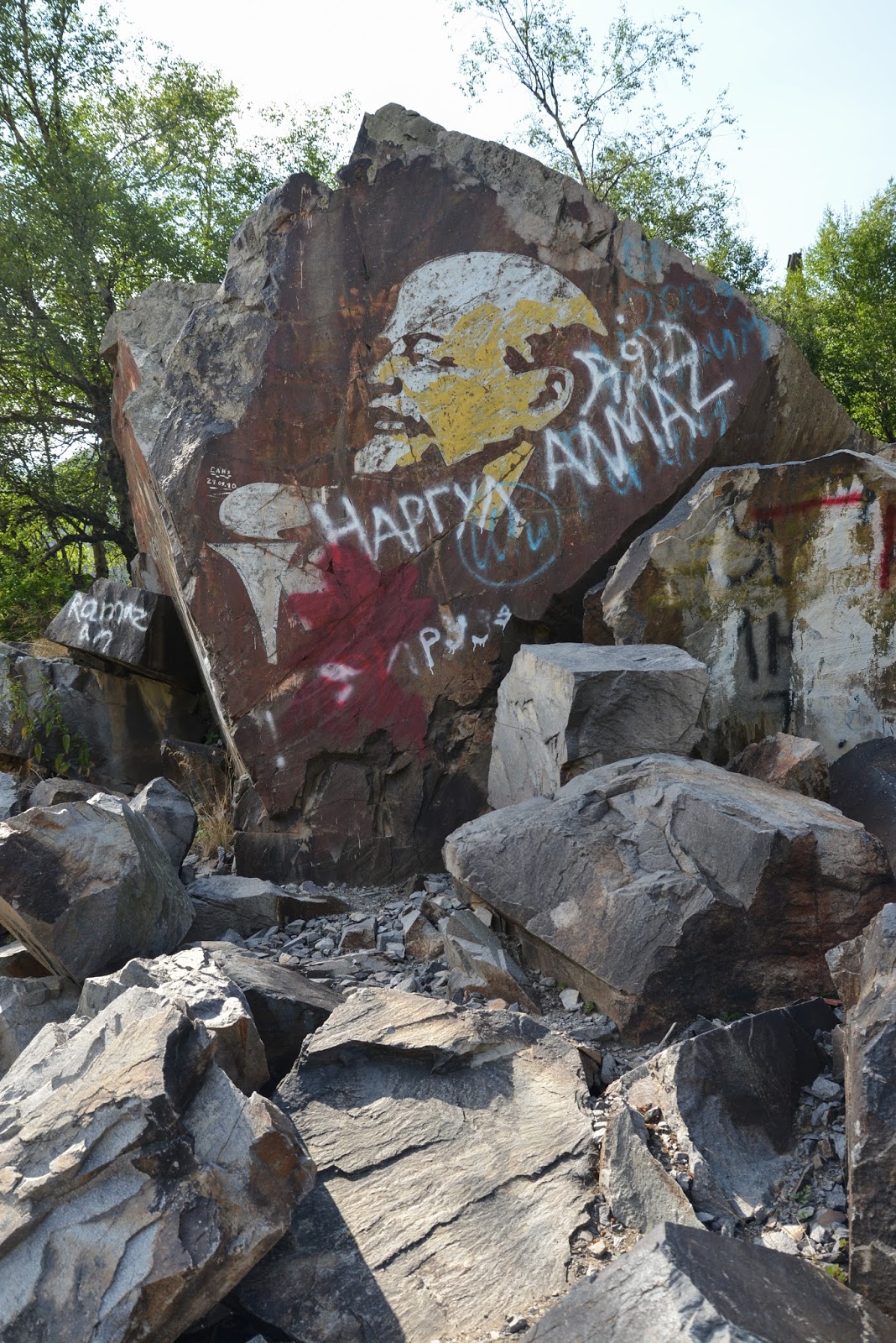
Communist Graffiti
Card Game
Shashlik
Playing with Campfire
Across the Barrier
Pretty Flowers
In Conclusion

Calvin's and my stay in Kazakhstan was a short one--only two weeks. I might have stuck around longer had my passport allowed it, but my entry stamp gave only 15 days and an extension would have required a proper paid visa. It was probably for the best we left sooner than later. Traveling in Kazakhstan had cost much more than expected. So from Issyk Lake we returned directly to Bishkek in adjacent Kyrgyzstan. It was right opposite the border from Kazakhstan yet everything was immediately cheaper. What a relief, we thought and breathed easy knowing our cash would stretch further. We were also happy to return to the same hostel we had stayed at before with its nice garden and good wi-fi connection.

If I have any lasting impression of Kazakhstan its that the country is large and mostly flat. For example, on our 20-hour bus ride from Astana to Almaty the view to either side was of yellow steppes interrupted only by the occasional rise of mountains in the distance. It did not change until at the very end in the greener south. Anyhow, these were the same steppes the Mongols had crossed en route to their great conquests of the13th century. Without any natural barriers to block their passage they wreaked havoc as far as the Middle East and Eastern Europe. Over the centuries Kazakhstan has seen several such empires rise and fall, and each has left a lasting mark ending with the Soviets. Now that the country is independent, where it goes from here is anyone's guess. Blessed with natural resources it would seem a bright future lies on the horizon but government corruption and strong traditions stand in the way of progress. Only time will tell.
Cows on the Steppes

Sunday, July 5, 2015

On the Road: India

Strider

I'd been on the road for 6 months, a journey that took me to India. I purchased a 30 day e-visa beforehand, and considering the size of the country, that wasn't much time to visit. I also wanted to go at a moderate pace because traveling is exhausting. But it's exciting to hit up several places rather than spend too long in any one spot. So I've been trying to strike a good balance and I was thinking I'd finally hit my stride in India. It couldn't come at a better time. My first visit in 2010 taught me how demanding a place India is to travel through, and if I didn't feel at ease heading in, the people and aggressive culture might quickly become overwhelming.


I've been dealing with loneliness recently as well. It makes me wish I had a travel buddy--someone to talk to and share all these awesome experiences with. The trip would be cheaper too, because we could split the cost of a room, taxi fare, and so on. But it's not as if I am entirely alone. There've been plenty of other tourists on the road. The problem is our travel plans have not matched up well and after only a few days we tend to part ways. Yet when on my own, there's an upside. It becomes easier to meet locals. On the road I've learned a great deal from these people and valued our time together. You see, it all goes along with my personal motto: The more you know, be it about culture, language, movies--whatever--the easier it is to talk to and identify with others. So never stop learning.


Another thing I've benefited from is introspection. Traveling challenges a person to think differently, and moreover, to reflect on where they stand in life. And for me this trip hasn't been a break from an established routine, but rather an end to a decade spent in Asia. So I keep looking ahead to when I return to America. It's a daunting prospect after so long abroad. But because I'm an optimist, I figure everything will work itself out. The same attitude applies to the road. No matter the destination good things await me. I need only to make an earnest attempt to get on well with others and keep an open mind. From what I've experienced so far on this trip, people do in fact repay kindness with kindness. Who knows? Maybe karma plays a part too.
Another Country
Kolkata

It's no secret that India has tons of large cities. They are massive and densely populated, and New Delhi is the biggest. Next comes Mumbai. Third is Kolkata. Having seen all three, I can attest to how different they are. Delhi is the monstrous capital with a modern metro and countless monuments. Mumbai is on the coast, has beaches, and several interesting sights of its own. Then there is Kolkata. I only recently visited the city, arriving at the airport from Dhaka in Bangladesh. The two cities were once part of the same region of Bengal and have a shared culture and language, but by comparison, Kolkata is more developed and organized. Much of it has to do with the role Britain played in putting Kolkata on the map. Once a sleepy village on the River Ganges, British tradesmen turned it into a major commercial center, and after heavily fortifying the town, established it as the capital of their prized South Asian colony. This legacy is evident in the many Victorian style buildings that have survived to this day. English is also widely spoken by the locals, something of a relief after Bangladesh.


Again, I decided to couchsurf, keeping in mind that I could use a local's help to become situated in yet another unfamiliar destination. My host Tinu lived outside the city on the campus of a university called India International Management. He was studying for a phd in marketing and had a big presentation to prepare. This meant he didn't have time to show me around, but he explained how I could get into the city and what I might see. The first place I checked out was the Victoria Memorial, a large building erected for the Queen's 75 year jubilee. The rest of the day I walked around the central city, then returned to Tinu's dorm and enjoyed a few drinks on the roof with his friends. The following morning, I ventured north to Dakshineswar and Belur Math Temple. Both are on the River Ganges, and for 10 rupees a small boat ferries visitors form one side to another. Unfortunately, at the latter, pictures were prohibited (though I did sneak a few). Speaking of which, there were several places in the country where they did not allow photos. Or sometimes they charged a camera fee. Either way it was a annoying for a photo enthusiast like me.


In total I spent four days in the city. On the third I met Brian, an American I'd known from before in Malaysia. He was now with his parents and we went out for dinner near the New Market. We talked over beers about traveling and how it's changed over the last 30 years. I soon realized that not only was Brian well traveled, but his parents too, as well as his brother and sister who I had yet to meet. In this regard I was a bit different, because few people in my family have gone places, and even less overseas. The exception is on my father's side. A few aunts and uncles travel. But it was my grandparents who did the most. Once retired they spent 20 years globe trotting, and they always brought back souvenirs and stories which inspired me to one day travel myself. I suppose me going to India was a result of that. And I was happy to be there where I met my American friend Brian, and Tinu, a kind and talkative host who told me much about the area.

Victoria Memorial
Bus Ride
Breakfast
Side Street
Dakshineswar Temple
Ganges at Sunset
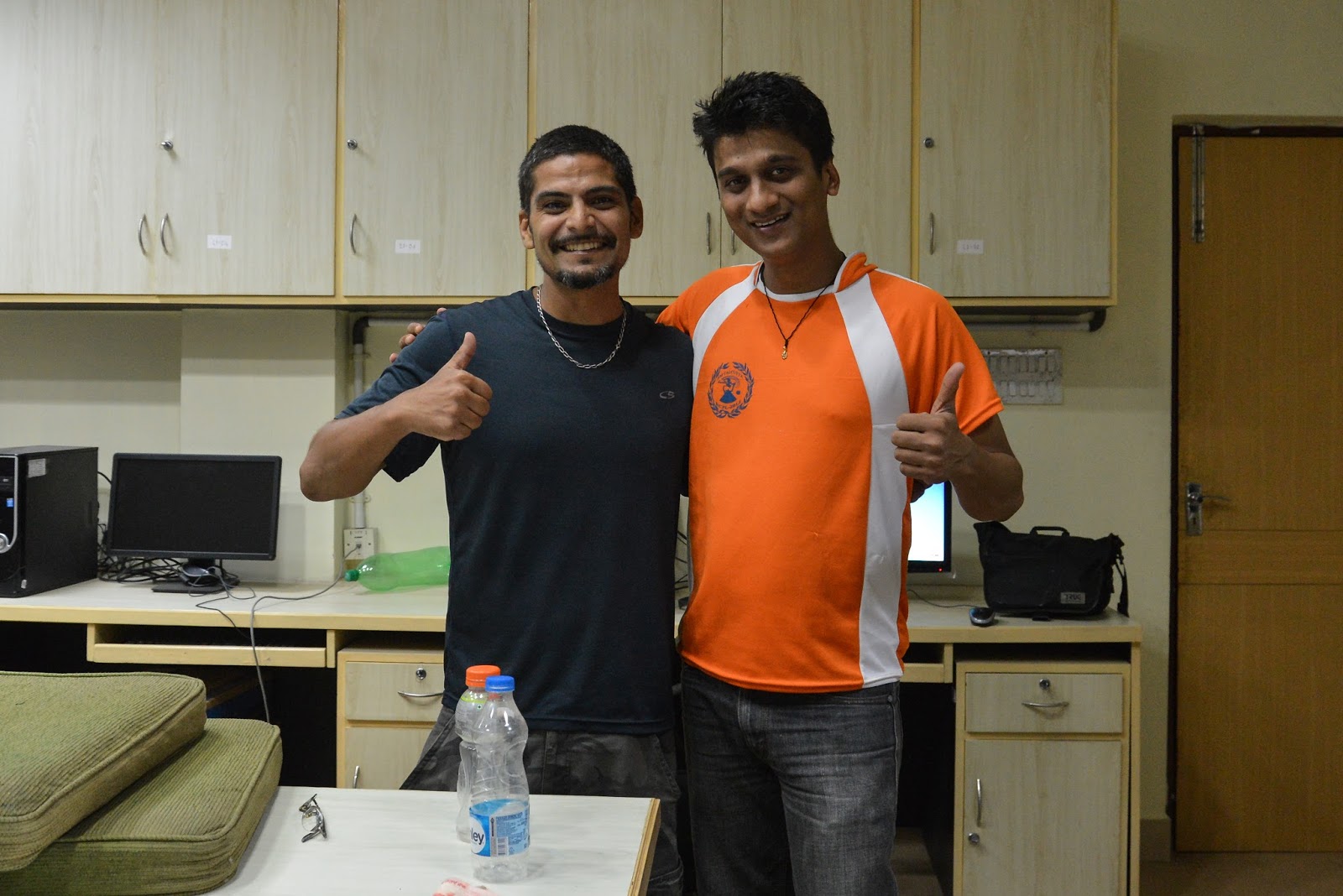
Tinu and Me
Mother Teresa

In Kolkata I had one last place to visit--the place where Mother Teresa had lived while helping the poor. She chose to spend most her adult life in the slums of the city, and for her efforts the Nobel committee awarded her the Peace Prize in 1979. Yet her work was not without controversy. For one, she strongly opposed the use of contraceptives. The Catholic church was also against them at the time so I can understand why. But what doesn't make sense was why she forbade the use of anesthesia. Well, she did give one reason, stating that pain brought people closer to God. But I don't think these words gave much comfort to those she took into her House of Dying. Created as a place for homeless people to pass away with dignity, the facility cared for the terminally ill, performing whatever final rites were appropriate for their faith. For example, for Hindus, staff gave out water from the Ganges, something that would supposedly help them move onto a better life in the ongoing cycle of reincarnation. That was kind and all, but pain killers would have been better, especially when tweezing maggots from the limbs of those suffering from gangrene.


At any rate, I won't put Mother Teresa down. She was a living saint who became beautified by the Pope not too long after her death. To achieve true sainthood though, two miracles must be accredited to her, only one of which has. In 2002 a medallion given out by Mother Teresa apparently cured a woman of ovarian cancer after it was placed on her stomach. While reports of other miracles have surfaced, the Vatican has yet to acknowledge any of them. I learned this while visiting her Motherhouse. The neighborhood is no longer a slum, and the house has been expanded and renovated. On the first floor was Mother Teresa's tomb. The message "Live Only For Jesus" had been written in flower petals on the flat marble lid. Across the courtyard and above the kitchen, was the room Mother Teresa lived in for 50 years. It was modestly furnished and without a fan. She was there, lying in bed when she passed away on September 5, 1997 at the age of 87. At the time she'd been suffering from all manner of ailments including malaria, osteoporosis and heart disease.


After her death Mother Teresa received a state funeral, an honor which has occurred only a dozen times in India, and the first for a foreign born national. In the years since, her legacy lives on through the programs she created, most notably the Missionaries of Charity. A person may join indefinitely by taking up the same vow of celibacy, obedience and poverty as Mother Teresa did, though most people choose to only volunteer for a period of time. Kolkata had several facilities that take them in, and I saw some Western-looking volunteers around the Motherhouse. Perhaps had I planned accordingly, I could have helped as well, because serving the poor is without a doubt an admirable cause. And even in this day and age there are plenty in need of help in Kolkata. As mother Teresa had once said, the greatest tragedy of these people's existence is not their lack of food and a roof, but rather the absence of love in their lives. In other words they are largely ignored and marginalized by society. Mother Teresa made it her mission in life to change that.

Outside Motherhouse
Tomb
Boys Nearby
School Where Teresa Taught
Holy Land

Samsara--the cycle of rebirth--is a central belief in Hinduism and Buddhism, two religions both native to the Indian subcontinent. To escape this cycle these religions have different approaches. In the case of Hinduism there are a multitude of sects that adhere to varying dogmatic views, though with Buddhism, the answer is clearer. It began some 2,500 years ago with a man named Siddartha Guatama. Born a prince in modern day Nepal, he became troubled with the nature of life and left behind the comforts of his palace to venture south in search of an answer. After studying under many spiritual teachers he secluded himself to a cave and became an ascetic. Years later he emerged and wandered to a nearby town where he found a tree. Still perplexed by the mysteries of man's inescapable existence, he sat beneath this Bodhi tree and assumed the lotus position. It took three days, but the answer finally presented itself, an enlightenment known as Nirvana. He realized that to be free of the cycle one must follow the middle path between the extremes of asceticism on one end and self-indulgence on the other. Moreover, he came up with the four noble truths, itself an eightfold path to achieve not only enlightenment, but a means to have a more fulfilling life.


Ever the curious traveler, I went to Bodhgaya, the town where Guatama became enlightened. A century after his death the Maurya emperor Ashoka erected a temple behind the very Bodhi tree which Guatama sat beneath. Unfortunately the tree was later destroyed by Ashoka's wife. A descendant now takes its place. The temple is no longer the same either. It underwent several reconstructions and renovations, the last of which was carried out by British archeologists. When I went to the temple grounds I experienced a flush of wonder, knowing a definitive moment had occurred where I stood. For the Buddhist monks gathered around it was the most important pilgrimage they could make. Clad in saffron robes they sat in meditative prayer hoping to grasp at the truth of their existence. Later I met some locals who were kind enough to take me to the Dungeshwari Cave. There in a small depression half way up a stony mountain face was the spot where Guatama spent his years of acetic isolation. Again, I found myself drawn into the past, a part of me connected to something deep and profound. But between these two moments in Bodhgaya and Dungeshwari, I came to no great realization. In truth I was never looking for any answers.


There was one last important place to visit. According to legend, Buddha left Bodhgaya and wandered west. After crossing the River Ganges he met five of his former companions in the town of Sarnath. It was with them that he first shared the knowledge he'd acquired through his enlightenment. I went to the town and saw yet another temple commemorating Buddha's life. Ashoka the Great had also visited the spot, and when he did, he left behind a large stupa that stands until today. Moreover, as in Bodhgaya, many temples and monasteries were in the area. Buddhist groups from the various countries had built most the temples, and each possessed a style of architecture that differed from the next. Visiting them was like taking a mini tour of a dozen countries spread across Asia. How one man had such far-reaching influence is an incredible testament to the desire people have to overcome the hardships in their lives. In the beginning Buddha's teachings were a philosophy to help guide them. Over the centuries though, Buddha became deified by the followers of this philosophy and there began the strong religious undertones which evolved into what Buddhism is now.

Mahabodhi Temple
Statue inside
Bodhi Tree
Mountain Hillside
Place of Meditation
Japanese Style Buddha
Temple in Sarnath
Buddha's First Disciples
Anonymity

India is a large country with many ethnicity groups, languages and cultures. After I began my journey in Kolkata, I moved northwest, seeing the changes from region to region. Surprisingly, regardless of where I went people mistook me for a local. Even other tourists made the same mistake. I can't begin to recall how many times I was told I looked Indian. I'd have to explain afterwards that I was an American of Mexican descent. Some of the locals did not seem satisfied with this response. They insisted that I must've had a bit of Indian in me. Hearing this again and again, I recalled that my Aunt Gloria had done some research regarding the genealogy of my dad's side of the family. She discovered that there is Navajo and Dutch blood in our veins. So who's to say there's not some Indian ancestry on my mom's side?


What was interesting was that I'd visited India before with my friend Dan, and since we were always acting like tourists together I didn't get the same reaction back then. So I now ask myself, did having the appearance an Indian appearance give me some kind of advantage this second time around? On the one hand, touts and other unsavory characters left me largely alone, and on the other I was approached by ordinary people who spoke to me in a language I didn't understand. When the latter happened I'd give a little confused shrug. If the person persisted I'd have to admit I was a foreigner. This led to a bit more confusion and awkwardness. That's not really an advantage in my book. But one thing I did definitely benefit from was getting into paid sites for the local price. I needed only to know two words of Hindi, "one person," and it was enough. I was never questioned or outed as a foreigner in these instances. In the end I saved around $10.


It sounds a little silly, but I wonder how much my life would have been had I lived the last 9 years in India instead of Japan. In Japan I was never able to fit in as a local. My face alone marked me as an outsider no matter how well I spoke the language and knew the culture. They wouldn't have considered me Japanese even had I stayed a thousand years. But in India it was the opposite. People were all too ready to accept me by my looks alone. So if I did spend the time to learn the language maybe I could have become one of them. Just another regular Joe on the streets of Mumbai or Delhi. I might have even risen up to become or person of importance, say an actor. Imagine. It could be me headlining Bollywood films now, the same as that one dude with the big nose, Sharukh Khan. But who am I kidding? I can't sing worth a damn and I'm not much of a dancer.

Random Guy on Train
Holy Land II

If a holiest of holies exists in India, it's Varanasi. It also happens to be one of the oldest continually inhabited cities in the world. Many Hindus visit to burn deceased family members on the banks of the River Ganges. The belief is that this will lead to eternal salvation by releasing the person from the cycle of rebirth. I went to the area where their bodies were placed upon stacks of wood and lit aflame. Different areas represented the caste hierarchy of the dead. The funeral pyres held higher up from the river were for Brahmas, while those burned closer to the water were of the lower classes. Photos were forbidden. I tried regardless but was always spotted by a local who then shamed me into putting my camera away. Too bad because the scene was incredible to see. The fires burning 24/7, black columns of smoke rising towards the heavens.


Another facet of Varanasi was the tourism. After Agra and its Taj Mahal, Varanasi probably had the highest concentration of tourists in India. And like any place overrun by tourists there were the expected touts and aggressive street vendors. The worst area was along the riverside where every thirty seconds a boatman asked to take me out on the River Ganges. It didn't matter if you were a foreign or local tourist, they became pushy walking along behind, saying they had the best rates. When I went, it was in the deathly heat of summer, and not so many tourists were in the city, which in turn made the touts hustle harder. Their incessant swarming was a constant nuisance, but I still spent a lot of time exploring on foot. To avoid the sun and touts I often went into back alleys. The narrow corridors twisted and turned like a maze, and trying to move in any one direction became impossible. But it was good fun to pass through the colorful alleys and see locals go about their daily lives. Many times I'd come to a place where kids played cricket. It was usually only a batsman, a bowler and two or three fielders, and yet they were enough to make the game work in the limited space available. I was asked at times to join in. A few swings with the bat was enough for me. Cricket like baseball is a sport I've never much been keen on.


In Varanasi two Dutch sisters checked into my hostel. We spent some time together sightseeing, and I'd have the visited the same places regardless, save for one. The girls wanted to set up a business connection allowing them to sell Indian made silk scarves in Europe. So we went to a local silk factory that came recommended in their guide book. The guy running it explained how a partnership worked. He sold scarves at a special reduced price to buyers and then delivered them via express mail. Anything in stock could be purchased right away. Otherwise the girls would have to place an order which would then be made at the factory. Also, an order had to be certain number of items or more. It all seemed very straightforward and at the end of the meeting the sisters bought several scarves to take home as samples. They could later compare them to similar scarves sold in Europe to figure out an introductory price then buy more to get the business started. I was thinking with my savings I too could set up a small operation in America. Then I shook the thought from my head. Better to spend that money traveling. 

Ganges at Sunset
Lassi Maker
Sleeping on Roof
Evening Ceremony
River Bathing 
Backstreet
Cows Eating Garbage
Posters
Waiting for a Customer 
Flower Offerings
Mountain Region

If I haven't made it clear already, the summer heat in South Asia was a force to be reckoned with. Day after day I walked around in the sun, the glare oppressive and unrelenting, and yet I managed to survive like this for 6 weeks. That was my limit. In Varanasi the 40 plus temperatures broke my spirits and I had to escape, so I took a train, and then a bus, and I didn't get off until I reached the mountain town of Srinagar. Oh what wonderful weather it was there. Sunny but cool. Blue skies and bold green mountains. In this region of northern India called Kashmir, the people were a mix of Afghani and Persian ethnicities. Their culture too reflected this ethnic past, and the day I arrived the Muslim period of Ramadan had begun. Some places still sold food and I felt bad getting a meal during daylight hours. But I couldn't help it. Sightseeing is hard work, and even more so on an empty stomach.


Anyhow, Kashmir is a problem area for India. It wasn't exactly brought into the fold peacefully. After the British partioning of the subcontinent in 1947, the Maharaja of the Princely State of Kashmir had the choice of deciding which side to join, Hindu India or Muslim Pakistan. He couldn't make up his mind. Himself a Hindu, his people were predominantly Muslim, and either which way he went he would've had to deal with a troublesome backlash. Due to his hesitancy, Pakistan stepped in and forced the issue by invading from the west. In desperation the Maharaja turned to India for help. On the agreement that Kashmir became part of the Union of India, the Maharaja received military support and that settled the matter. But the Kashmiri people were not happy under this new rule. For one, they did not see themselves as Indian culturally or ethnically. A few decades later, things turned worse when Pakistan again invaded sparking another war. The Indian government drove them out, after which it took away much of the region's autonomy, making it a kind of military state with soldiers stationed everywhere. The Kashmiris were not pleased by this. They tried to regain some political control through the available channels, but when that failed, a number of extremists turned to terrorism. And there the situation stands. Enemies within and without, the Indian government controls Kashmir with an iron fist. Having visiting the place, I must say, it did feel like an occupied territory. Soldiers with guns stood guard everywhere--on the street corner, along the highway, and in countless bases surrounded by steel fences and barbed wire.


It's quite sad really. The Kashmiris are open, friendly people, and they deserved better than the ugly pool of political muck European colonialism left in its wake. As a tourist however, I couldn't get too bogged down by their unfortunate situation. I had places to see, dishes to try and photos to take. One highlight of my stay was Dal Lake, a pleasant splash of blue nestled between gentle mountains. Small tour boats drifted lazily on the lake's calm surface. Not wanting to miss out on the fun, I paid a few bucks to be paddled around in the open. Later the boat went into the quiet waterways which fed into the town's old quarter. Other than that I walked the streets, saw the local mosques and talked my way past some soldiers who guarded the old fort. For some reason the fort had been closed to tourists for decades. Once I got in, I gazed down on Srinagar, clear and vibrant in the last light of the afternoon sun. This view of the city evoked a different way of thinking. It was also a nice place for taking pictures.

Green Mountains
Kasmir Mosque
Clothing For Sale
Playing at Fountain
Fort on hill
Looking Down
Kashmiris
Dal Lake Canal 
Local Boys
Photography

For anyone who takes the time to read my blogs, there are certain themes that come up again and again. The most prevalent is my struggle to see the world on my own terms. It's not an easy undertaking. Often I must push myself to great lengths to to make it over the next horizon. And by traveling alone, and at a fast pace, I have to deal with loneliness and fatigue for many stretches of the journey. Most the time my only companion is my trusty D600 Nikon camera. I take it wherever I go, slung across my shoulder in a black bag. In fact if I didn't have something to take pictures with, I'd probably have skipped half the spots I've gone to on this trip. What a pity the would be. I might not return to many of these countries, so I feel I've got to make the most of my time. Having a camera with me is good in that it helps me remember what I see and experience. That's is half the point of photography, because the way I see it, pictures capture a time and place as it was, and sadly, will never be again.


Sometimes I discuss with other travelers the purpose and execution of photography. There are several schools of thoughts. I find a large chunk of travelers are satisfied with their smart phones, and even then they may only snap a few photos a day. To them my black beast of a camera looks cumbersome and unwieldy--in other words, too much trouble to carry around. The same type of traveler may also argue that I spend too much time focusing on photos. "Just lay back and enjoy," the person might say. "You don't need a picture of everything." Ok, that's a good point. While I'm running around trying different angles, I might gloss over a moment, or even miss it entirely. But the truth is most moments last for minutes if not hours, and they can be enjoyed in different ways. My other counterargument is that photography gets me to see more things. So yeah, that panoramic view of the valley looks splendid in the afternoon light. But how would it look a few hours later at sunset? While most everyone else has wandered off, I stay behind with my camera to find out.


I should also add that photography is a skill. It takes effort to develop, and like most things, lots of practice. That said, if you want to improve, get out there and have at it. The more shots you take, the better your understanding will become about light, composition and perspective. But more importantly having tons of photos creates a larger pool of work to draw from. Just don't go overboard with the amount you save and then share with friends. Because believe me, more is less, and it's why five good photos make a much stronger impact than those same five photos mixed in with twenty mediocre shots. How many times have I seen this on facebook? 50 pictures put up, many of them of the same thing. It's not that I'm not taking the photos in the same manner, but at the end of the day, I'll only share about 1 out of 50. The results speak for themselves. The pictures I have on facebook are solid, thoughtfully chosen images that represent a telling glimpse of what I do and experience. If I'm lucky 1 in 5 of these photos is good. And perhaps 1 in 50 is great. Those are the standards I hold myself to. But it means getting out there for hours at a time to capture the thousands of photos needed to yield satisfactory work.


The point is photography has never been easy for me. Nor has it merely been about visiting exotic places. Regardless of the location, my photos come out better than those of most other people for a reason. Some of it has to do with knowledge and technical knowhow. But the real difference is that an amateur takes one or two shots and walks away. A serious photographer will take 25. That's dedication to one's craft. Owning a good camera is also helpful. The improved image quality stacks up on top of the other factors I've mentioned, producing better results. But having an expensive camera alone, without a photographer's understanding to back it up, well, it's like buying a fancy house and then filling it with tacky, random furniture. Don't expect the photos to turn out well. On the upside, the problem can be tackled head on. It's just a matter of time and effort to develop the needed skills.

My Baby
Capturing the Moment
Ledakh

The Jammu and Kashmir region of northern India is not limited to only Muslims. There are the Buddhists in Ledakh as well, a kind of Tibetan people with faces more Asian than anything else. If there was one place in India where I did not blend in, this was it. My body was not prepared for the cold either. Coming in from Srinagar, I winced at the pronounced drop in temperature, and then remembered why I'd considered not to going so far north.The dryness also ate at my lips and skin, peeling away the outer layer of epidermis. So strange a place Ledakh was. A desert in the high mountains, divided from green, verdant Kashmir by the backbone of a high range. I couldn't tell you their names, but I will say that there was snow in these mountains, even in June. Poor me. I had only my hoodie to keep me warm and it proved to be very inadequate. I was still happy to visit Ledakh though. The regional capital of Leh had a Tibetan Buddhist Monastery overlooking the town, and in the streets vendors sold their veggies, dried fruits, woven fabrics and other mostly handcrafted wares.


There were plenty of things to see in Ledakh. The first was Pangong Lake. I had to ride a bus for 10 hours, including over a 5300m pass to get there. 5300m is very high mind you. It's higher than any place in the continental US and I was also hungover at the time. This made the narrow switch backs and bumpy road a living nightmare. As if that weren't bad enough, the altitude sickness drove the chisel of pain deeper into my head. But I survived and saw the clear water lake. I then stayed the night, setting my alarm for 1AM so I could take pictures of the stars. Man was it cold, me standing out alone, a piercing chill having penetrated every pore of my body. And there were dogs. They growled and barked from the surrounding darkness. Yet I refused to be intimidated. If one came close, I shouted it away, and if that didn't work I threw a rock in its direction. The projectiles kept even the most vicious of them at bay and I could take my photos. Some might think me crazy to go through all this trouble for some night time shots, but again, I love photography and it's this passion which keeps me going. Plus the Milky Way overhead was a sight to behold. It formed a celestial rainbow that arced over the lake, alive with its own sparkling glow, and I had it all to myself.


Two days after Pangon Lake I was in a shared van headed the opposite way to Nubra Valley. This time we went over Khardungla Pass, the world's highest vehicle road. It was something like 5,600m. The other passengers and myself got out to get a photo in front of the sign that marked the spot. It was cold, and the altitude sickness again shot through my head like a hot arrow. When we came down to the valley on the opposite side we passed out of the Tibetan area of Ledakh and into another Muslim stretch of land. These northern reaches of the valley had been completely closed off up until 5 years ago, and though they had since experienced a sudden surge of tourism, the local villages retained their natural character. A lot of it had to do with the short tourist season--only three months in summer. The rest of the year the entry pass was closed which made the valley inaccessible other than for military flights.


In Nubra Valley we went as far as Turtuk village where the local people were of the Balti race. Years before their land had been part of Pakistan, but that war I wrote about earlier--the Pakistanis lost, and with it they gave up some territory. Life in the isolated valley did not change much either way and the Baltis seemed to have no qualms being under Indian rule. I talked about this with the staff at our hostel. My friends from the van ride joined us while we sat beside a campfire, as did some Indian tourists who had come in by their own rental car. The fire was bright and glorious, or better put, it was a necessity. To keep warm we kept it burning for nine hours until we'd used every branch, twig and rotting trunk in the vicinity. Of course we were also drinking alcohol, yet the following morning, hang over and all, I got up early to take photos of the village. Turtuk rose into the valley hills, a setting of mostly barley fields with houses and trees scattered throughout. My initial focus was on the villagers. I wanted to get some portrait shots but the people had an unexpected aversion to my lens. That left me with only the scenery to shoot. The place was nice enough, but in my mind, not the secluded paradise some other tourists had told me it would be.

Arrival in Leh
Market Street
Herd on Road
Three Stupas 
Snowy Pass
Pangon Lake
Milky Way
Highest Road 
Campfire
Village Girl
Barley Fields
Final Stretch

Saying goodbye to Kashmir and Ledakh I ventured back south via a long, unpaved mountain road. Eventually it lead down a sweeping valley and into the town of Manali. This was more of a Hindi town, and very touristy at that. In the part along the river, Indian tourists filled in the hotels on the main avenue. But in the upper reaches of Old Manali, it was foreigners who made use of the hostels. A large percentage of them were Israelis. In spite of being a small country with a proportionately small population, Israel is full of people who travel to India. Most are young adults. They go after finishing their military service and during the tourist season in some areas they take over towns. In Manali it had gotten to the point where many of the signs were in Hebrew. From what I've seen, these Israelis usually keep to themselves in large groups, often spending weeks on end in the same places. It's their way of unwinding before returning home to study or take up a career. Alcohol and marijuana help ease the passage of time. Manali had both. The latter grew wild along the town's roads, and out of curiosity I picked a leaf, crushed it in my fingers and had a sniff. It was definitely the real deal.


I only spent one night in Manali. The following day I had some time to explore, including a visit to a hot spring and a walk through the villages on the edge of town. I then took a night bus to Delhi. The transport was a normal city bus, packed and uncomfortable, and our arrival couldn't have come any sooner. After that it was off to the southern side of the city to the home of a couchsurfing host named Naveen. He lived alone in a spacious apartment, his only company a dog named Semmy. A bit of a shut in, Naveen worked from his bedroom on the Internet doing recruitment work for companies. As a self proclaimed foodie, he asked if it would be possible for me to cook some Mexican food. I said I could try and we went to the supermarket where I found the needed ingredients (I did have to substitute chapati bread for tortillas though). The result was chicken soft tacos with pico de gallo topping. Once full, we drank and talked long into the night.  I remember that Naveen spoke fondly of his two kids. He loved dearly, and above all else he wanted them to be happy, leaving it to them to discover how. This went against the typical view of Indian parents who often put pressure on children to succeed through rigorous study and a decided career track. 


Being in Delhi, I didn't have much I wanted to see because I'd visited before. There was only the Lotus Temple where Dan and I had meant to go back in 2010. A beautiful building to look at, I found the inside otherwise unimpressive. Perhaps I would have had a kinder disposition had they allowed me to take photos once I'd entered the main prayer hall. Still early in the day, I next checked out a place called Gwandara Bangla Sahib. A Sikh temple, the attendants practiced the custom of langar, which is the giving of food to visitors regardless of race, creed or gender. Since I hadn't eaten yet I readily accepted a platter of the food. It consisted of some spiced vegetables, lentil soup, rice and chapati. Served hot, the meal was quite delicious, and I had two helpings. The nutritional sustenance gave me the strength to make it back to Naveen's house and that was it for me in India. My flight out was the next evening. I did nothing more apart from writing part of this blog and taking a few portrait photos of Naveen at his request.

Manali River
Local Hindu Temple
Wild Weed
Metro Station
Lotus Temple
Gwandara Bangla Sahib
Eating Free Food
Enjoying a Public Fountain
Hard Thirty

Ok. All that business about me taking my time and seeing things at an even pace--it was a lie. Though I had the best intentions going in, India took hold and swept me along, because after I arrived in Kolkata and up until my second to last day in Delhi, I did not rest. It was simply one outing after another, and I'll be honest, traveling in this manner was taxing. From the sweltering heat of the south to the freezing temperatures of the mountainous north, I subjected myself to the extremes of the thermometer, all so that I could play the tourist. The question is, was it worth it?


Yes.


Very much so.


India is more than a country. It is a subcontinent with a thousand things to do and see. Had I taken a year to explore the country I would have came away feeling like I saw the place. In reality though, I only had a month. So I did what I could, and thinking back to how much I accomplished in that time, I'm quite pleased. I wouldn't give up a single one of those days. 


Until next time India. Farewell. 
Boy and Mosque